Burned the Countertop in a Rental? The Exclusion That Sounds Fatal and the Exception Under It
A renters policy appears to exclude damage to the apartment itself, then carves several perils back in. What that clause is doing, and how a tenant reads it before the landlord's bill arrives.
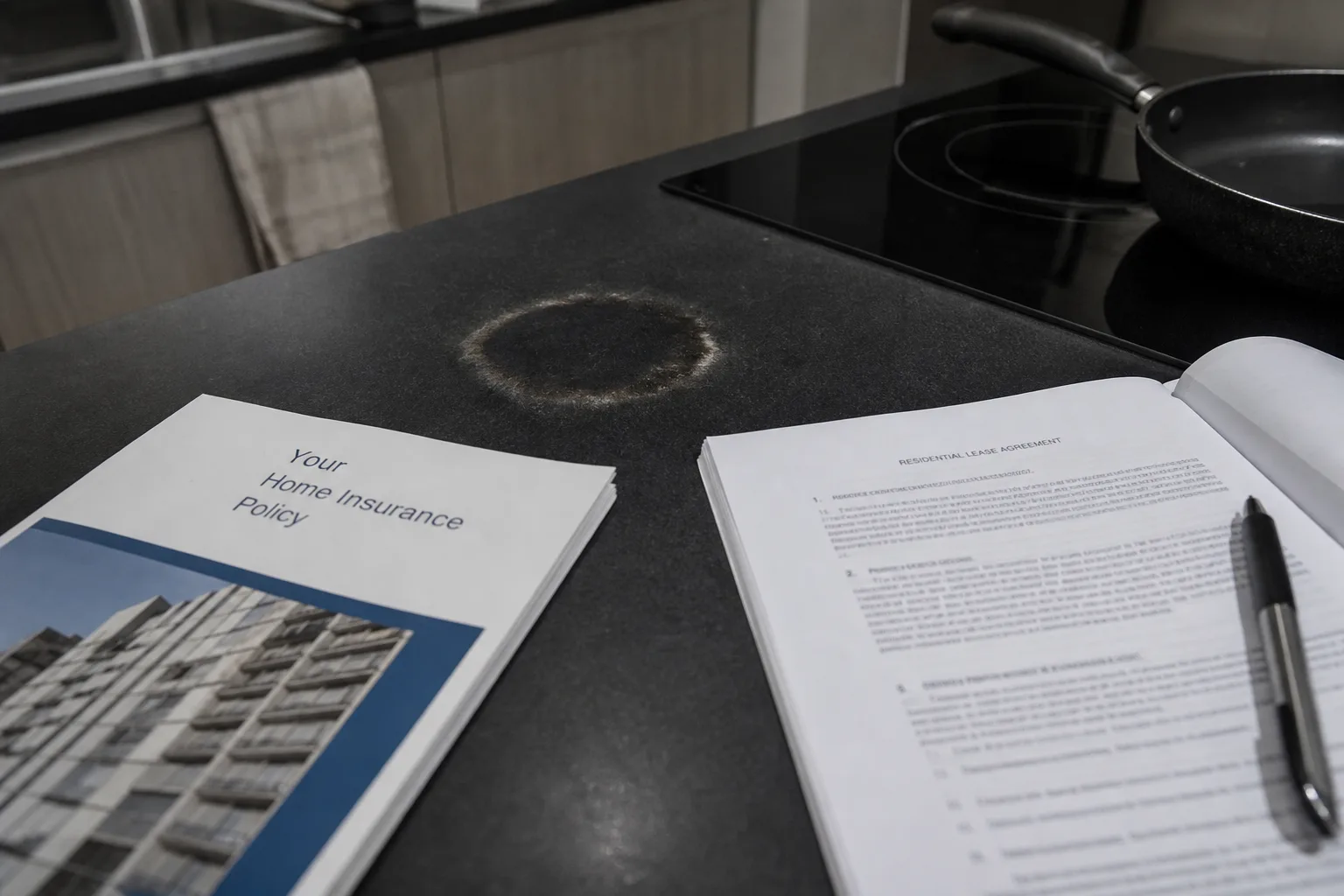
The clause that settles most small tenant disputes is not in the lease at all. It sits in the liability half of a renters policy, and it says, in one wording or another, that the insurer will not pay for damage to property you rent, occupy, or have in your care, custody or control. Read on its own, that sounds like the policy has excluded the single building you are most likely to damage. Read with the exception printed underneath it, it is doing something narrower, and the difference surfaces the first time a landlord forwards a repair invoice.
The assumption is that exclusions are escape hatches
Most tenants meet an exclusion for the first time in a denial letter, which is a bad place to form an impression of what the clause is for. The common belief that follows is that exclusions are drafted to give the carrier a way out after the money has been collected. The mechanical explanation is duller and more useful. An insurer prices a policy against a defined set of losses, and the exclusions are how that set is defined; every peril carved out is a peril the premium never contemplated covering. Some of those carve-outs exist because the risk belongs on a different policy, some because it is uninsurable, and a large share because the same coverage is sold separately as an endorsement to anyone who asks.
The narrow case: you damaged the unit, not a neighbor's
Take a single, ordinary event. A tenant sets a hot pan directly on a laminate counter, or drags a bed frame across a wood floor, or lets a bathroom faucet run into a downstairs unit. The liability section of a renters policy is built to pay when you are legally responsible for harming someone else's person or property, and a landlord's building is, plainly, someone else's property. Yet the care, custody and control exclusion sits in the way, because the apartment is not incidental to your life. You occupy it continuously, you control it, and a carrier that insured every scratch in a space you use daily would be underwriting wear rather than accident.
That is the boundary the clause draws. Damage a neighbor's ceiling and you are on the ordinary liability track. Scorch your own counter through carelessness and the standard policy generally treats it as your problem, in the same way it treats a dent in your own car as a matter for collision coverage rather than liability. The exclusion is not hiding anything. It is telling you which of the two situations you are in, which is exactly what you need to know before you answer the landlord.
The exception underneath is where tenants get their money
Standard renters forms rarely stop at the exclusion. Most carve several perils back in, and the usual set is fire, smoke and explosion, with water damage included on many forms. That carve-back exists because those are the losses that turn a small mistake into a five-figure repair, and because the entire reason a lease requires renters insurance is to put something behind a tenant when a stovetop fire spreads. So the same page that appears to strip out the apartment restores it for precisely the events that would otherwise bankrupt the person named on the declarations. A separate provision, commonly labeled damage to property of others, often pays a modest fixed amount without any finding of fault at all, useful for the broken window or the ruined carpet where arguing about negligence costs more than the repair.
Read in that order, the clause reads as a sorting device rather than a refusal. Cosmetic and wear-type damage to the unit stays with the tenant and, in practice, with the security deposit, where state landlord-tenant law governs what can be withheld. Catastrophic damage to the unit stays with the insurer. Damage to anyone else's property stays with the insurer. Three outcomes, one paragraph, and the only way to land in the wrong one by accident is to stop reading at the exclusion and assume the answer.
What to check while nothing is wrong
Pull the declarations page and the policy form together, because the declarations list the endorsements and the form contains the sentences. Find the personal liability limit, find the damage to property of others amount, then find the care, custody and control exclusion and read the sentence immediately after it to see which perils are restored. Then read the lease alongside it. Leases often require a minimum liability limit, name the landlord as an interested party, and occasionally include a waiver of subrogation, which stops the building's insurer from suing you after it pays for a loss you caused. That waiver is worth more to a tenant than an extra increment of coverage, and its presence or absence is knowable in five minutes.
If a specific exposure worries you, ask what it costs to add. Water backup from a drain, higher limits, and coverage for a home-based side business are commonly sold as endorsements rather than argued about after the fact, which is the practical proof that an exclusion is a pricing line and not a trick. Policy forms and the language in them are reviewed by state insurance departments, and the National Association of Insurance Commissioners develops the model standards those departments work from, which is why renters forms from unrelated carriers tend to track each other closely enough that reading one teaches you how to read the next.
The tenant who has read the exception knows something concrete before any conversation with a landlord: which repairs are a deposit question, which are a claim, and which are neither. That knowledge is free, it takes one careful pass through two documents you already have, and it is far easier to acquire on a quiet evening than in the week after a kitchen fire.