Certified Renovator Card Expiring? The Refresher Class Fills Long Before the Date on the Card
A lead renovator certification lapses on a fixed date, but the deadline that decides your spring is the course roster, and it closes weeks earlier.
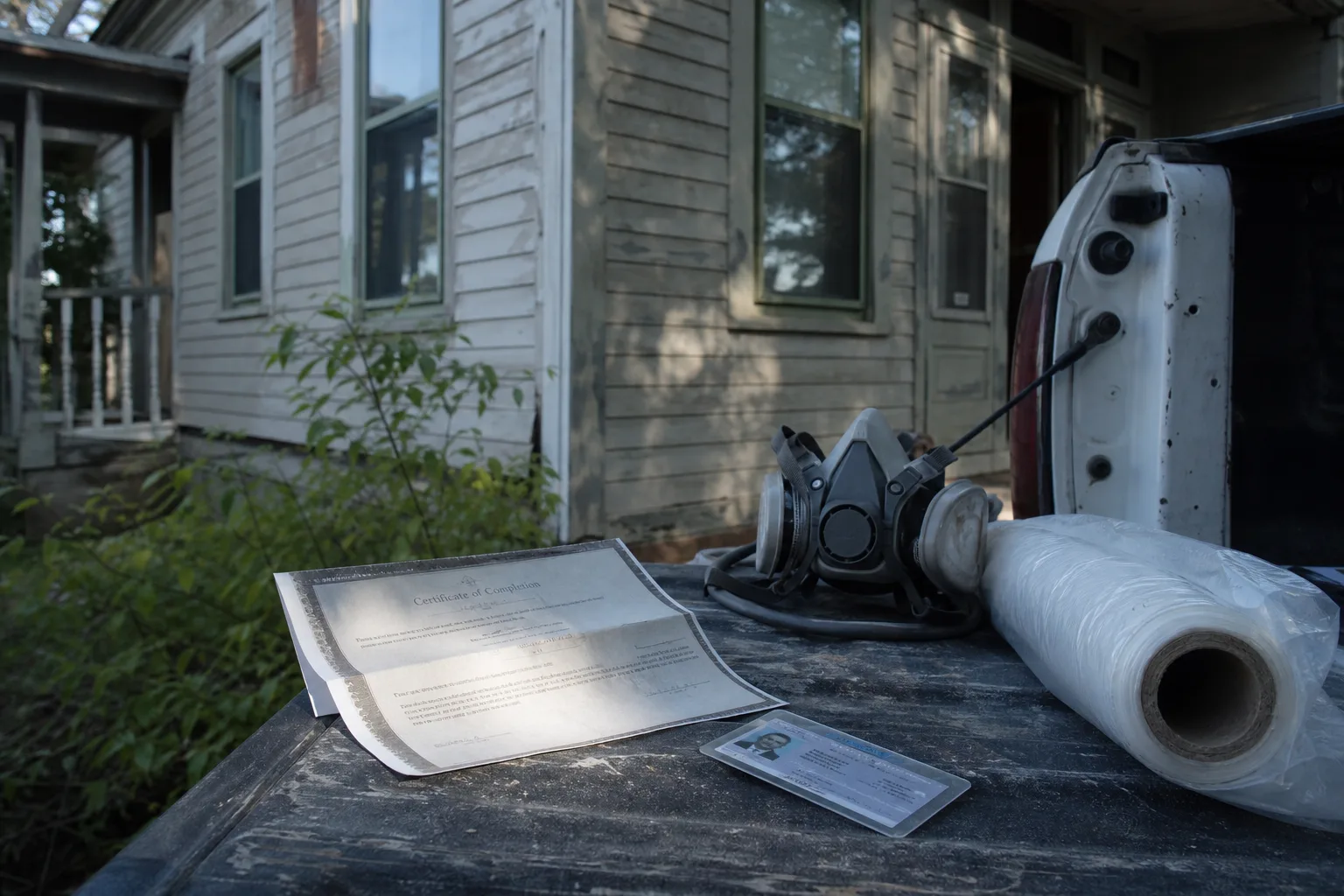
Work on a house built before 1978 and disturb paint beyond a small area, and the job carries a federal training requirement that sits behind everything else on the schedule. Somebody on site has to hold a current certified renovator credential, and the company has to hold a separate firm certification. Both expire. Neither sends a foreman out to the truck the morning it happens. The consequence usually shows up as something else entirely: a bid that gets set aside, a crew that cannot be split across two addresses, a homeowner asking for a copy of a certificate that nobody can produce that week.
The credential is attached to the building, not to the trade
The trigger is the age of the structure and the amount of painted surface disturbed, which means a painter, a window installer, a carpenter and a general contractor can all fall under the same rule on the same street. Older housing stock does not sort itself by trade. A 1920s two-flat with four layers of paint on the sash and a porch column that has been scraped every fifteen years is squarely inside the rule, and the work it needs is exactly the work that generates dust. The Environmental Protection Agency oversees the renovation, repair and painting requirements that apply to that housing, and the enforcement follows the address rather than the job title on the invoice.
Two deadlines, and the one that actually binds is the roster
The date printed on the certificate is the one people write down. It is not the one that governs. Refresher courses are taught by accredited training providers on a published schedule, and in most markets that schedule is thin: a handful of sessions a quarter, some of them cancelled for low enrollment, several of them full by the time a contractor thinks to look. The hands-on portion caps class size in a way an online module does not. So the operative deadline is the last session with an open seat that lands before your expiration date, and finding it in October for a March expiration costs nothing, while finding it in March costs a rescheduled week.
There is a second wrinkle worth checking rather than assuming. Some states and tribes run their own authorized programs in place of the federal one, with their own accredited providers, their own renewal intervals and their own paperwork. If you work across a state line, you may be holding two credentials with two different clocks, and the shorter one sets your calendar. Certain refresher formats also carry a shorter renewal period than others, depending on whether hands-on training is included. Ask the provider which interval the course you are booking actually earns you, and get that answer before you pay, not after the certificate arrives.
What a lapse costs, traced back
Letting the date pass does not simply mean taking the refresher late. Past a certain point the refresher is no longer available to you and the initial course is the only route back, which is a longer class, a higher fee and a scarcer seat. That is the direct cost, and it is the smaller one. The indirect cost is the job you could not staff: one certified renovator covering two crews means one crew waits, and a homeowner who was promised a start date in April hears about it in May. Contracts and insurance certificates increasingly ask for proof, and a general contractor assembling a bid package will drop a sub whose documentation is stale rather than argue about it.
The pattern I see on older buildings is that these gaps surface at the worst moment in the sequence, after the containment is planned and the dumpster is ordered. A lapse discovered in February is an afternoon of scheduling. The same lapse discovered on the Monday of a start week is a reputational conversation. Both are avoidable with the same twenty minutes of work, done in the quiet part of the year.
Setting the window so it holds
Treat the firm certification and the individual certification as two separate items with two separate reminders, because they renew on different cycles and the firm application has processing time built in that a class does not. Put a reminder at six months out and a second at ninety days, and make the six-month one an instruction to book, not an instruction to think about booking. Keep scanned copies of every certificate in the same folder as your insurance and license documents, so a request for proof is answered from a phone rather than a filing cabinet. Then check the training provider list once, early, and note which sessions run near you and how often.
The renewal itself is a short class and a modest fee. What it protects is a whole category of work on pre-1978 housing that nobody else on the bid list can legally do without the same card, which makes the seat you book in the fall one of the cheaper competitive advantages available to a small shop.