Chasing a Repair for Six Weeks? What to Record Now So One Legal Hour Counts
For tenants, the value of a first legal consultation is mostly decided in the ordinary weeks before it, by what you wrote down and what you can prove you asked for.
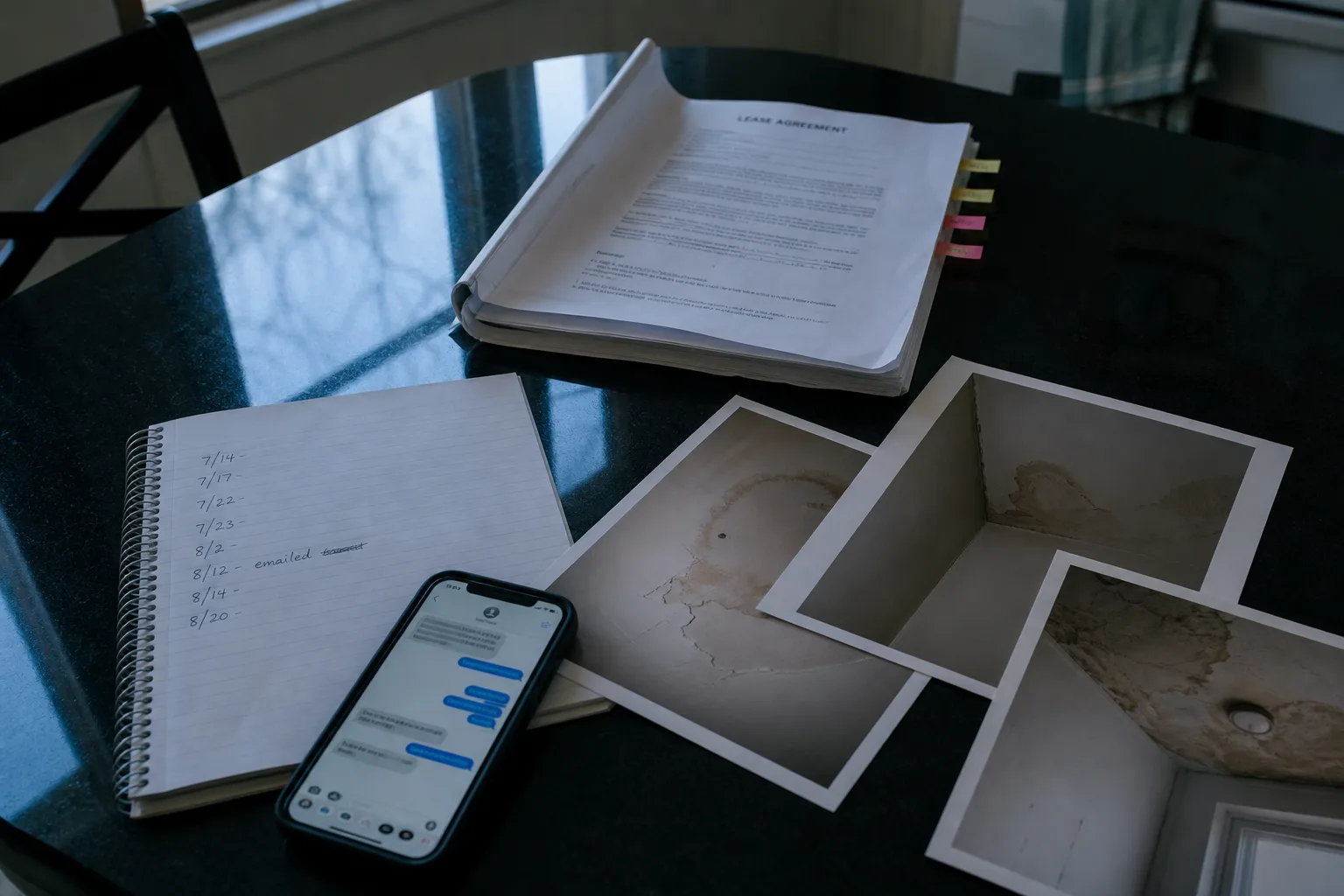
The useful part of a first meeting with a housing attorney is rarely the advice itself, which is often shorter and blunter than people expect. It is the sorting. Someone who has handled several hundred tenancies tells you which of your facts carry weight, which are merely annoying, and which deadline is already running. That sorting only works on material you brought, and most tenants bring a version of the story assembled from memory the night before, which is the weakest form the story will ever take. The material gets built in the ordinary weeks, or it does not get built.
The log is made on Tuesdays, not the night before
A repair complaint has a shape that only shows up when it is written down as it happens: the date you first reported the leak, the channel you used, the name of whoever answered, what they promised, and the date that promise expired without anything happening. Reconstructed later, all of that collapses into "I've been asking since around the spring." That sentence is worth almost nothing. Two lines a week in a notes app, written the day something occurs, produce a timeline an attorney can read in ninety seconds and immediately tell you whether you have notice, delay, and a pattern, or just frustration.
What to record is narrower than it sounds. Dates and channels matter most, because they establish notice, and notice is what converts a landlord's inaction into a legal position. A text message thread is better than a phone call because it timestamps itself. If you do call, send a short follow-up message afterward confirming what was said, which costs a minute and turns an unverifiable conversation into a document. Photographs want a date and a reference object. A picture of a stain tells nobody how big it is or when it appeared.
Learning which facts are load-bearing
Judgment here is mostly learning that your sense of what matters and the legal sense of what matters are different, and that the gap is predictable. Tenants tend to lead with tone: the manager was rude, the emails were dismissive, the contractor laughed. Those details are real, and they are usually not the case. What tends to be load-bearing is narrower and duller. Whether the condition affects habitability rather than comfort. Whether you gave written notice and how long ago. Whether you kept paying rent. Whether the lease says something specific about the item in question.
You can develop this instinct without a law degree by running each new grievance through one question before you file it away: what would I have to show a stranger to prove this happened, and does it change what the landlord was obliged to do? A broken dishwasher and a broken furnace in January both feel like breaches. Only one of them usually is, and knowing that in advance means you spend your paid hour on the furnace. Tenants who learn to make this separation arrive with three strong facts instead of twenty mixed ones.
Read the lease before you pay someone to read it to you
Most first consultations spend their opening stretch on the document you already have. That is time you can buy back. Read the lease cover to cover once, with a pen, and mark four things: the notice provision that says how and where you must send written complaints, the repair clause, anything about alterations and who pays to restore them, and the section on fees and deposits. Note the page numbers. When an attorney asks whether the lease addresses repairs, the difference between "I think so" and "clause nine, page four" is several minutes and a sharper answer.
Alterations deserve particular attention because they generate the disputes tenants least expect. A shelf anchored into drywall, a window unit, a lock changed after a break-in, a satellite dish, paint in the back bedroom: each one is governed by a sentence somebody signed, and the question of who pays to undo it usually turns on whether permission was asked in writing. If you are mid-tenancy and considering a change, the cheapest legal work available is an email requesting approval, kept in a folder, sent before the drill comes out.
Deciding who you actually need to see
Not every housing problem needs a private attorney, and part of preparing well is knowing which door to knock on. Local legal aid organizations handle eviction defense and habitability work for tenants under income limits, and they move fast because they have to. Many state and county bar associations run referral lines that offer a short consultation at a fixed low rate. Tenant unions and city housing agencies can often resolve a code violation faster than litigation would. The Department of Housing and Urban Development oversees federal fair housing enforcement, which is the relevant channel when the problem is discrimination rather than disrepair.
Choosing among these gets easier once you can state your problem in one sentence that names the outcome you want. "My landlord is ignoring me" routes nowhere. "I want the heat fixed and I want to know whether I can withhold rent until it is" routes to a housing attorney or legal aid. "I want my deposit back and the deductions itemized" may route to small claims, where you will likely represent yourself and a single paid hour of coaching goes further than full representation would. The sentence is the triage.
Arrive with a decision, not a story
Bring the timeline on one page, the lease with its marked clauses, and photographs in date order. Then bring the thing most people leave out: the specific choice you are trying to make, and the option you are leaning toward. Whether to withhold rent this month. Whether to sign the renewal they slid under the door. Whether to accept the settlement offer, or let the sixty days run. An attorney given a decision will test it against the facts and tell you what it costs if you are wrong, which is the most valuable output an hour can produce.
Write down the answers during the meeting rather than after, including the parts you disagree with, because the disagreement often turns out to be the point you misunderstood. Ask what deadline you are closest to, ask what would make your position stronger in the next thirty days, and ask what would make it weaker. Those three answers convert a consultation into a plan with dates attached, and they give the weekly log something to aim at for as long as the dispute runs.
The habit compounds. Tenants who keep a two-line weekly record find that their second housing problem, whenever it arrives, costs them a fraction of what the first one did, because the material is already there and the sorting instinct is already trained.