Cleaning a Built-In Gutter on an Old Roof? You Are Paying for the Eyes, Not the Ladder
On a house with a lined box gutter, the annual clean-out is really an inspection, and the wrong pair of hands costs more than the debris ever would.
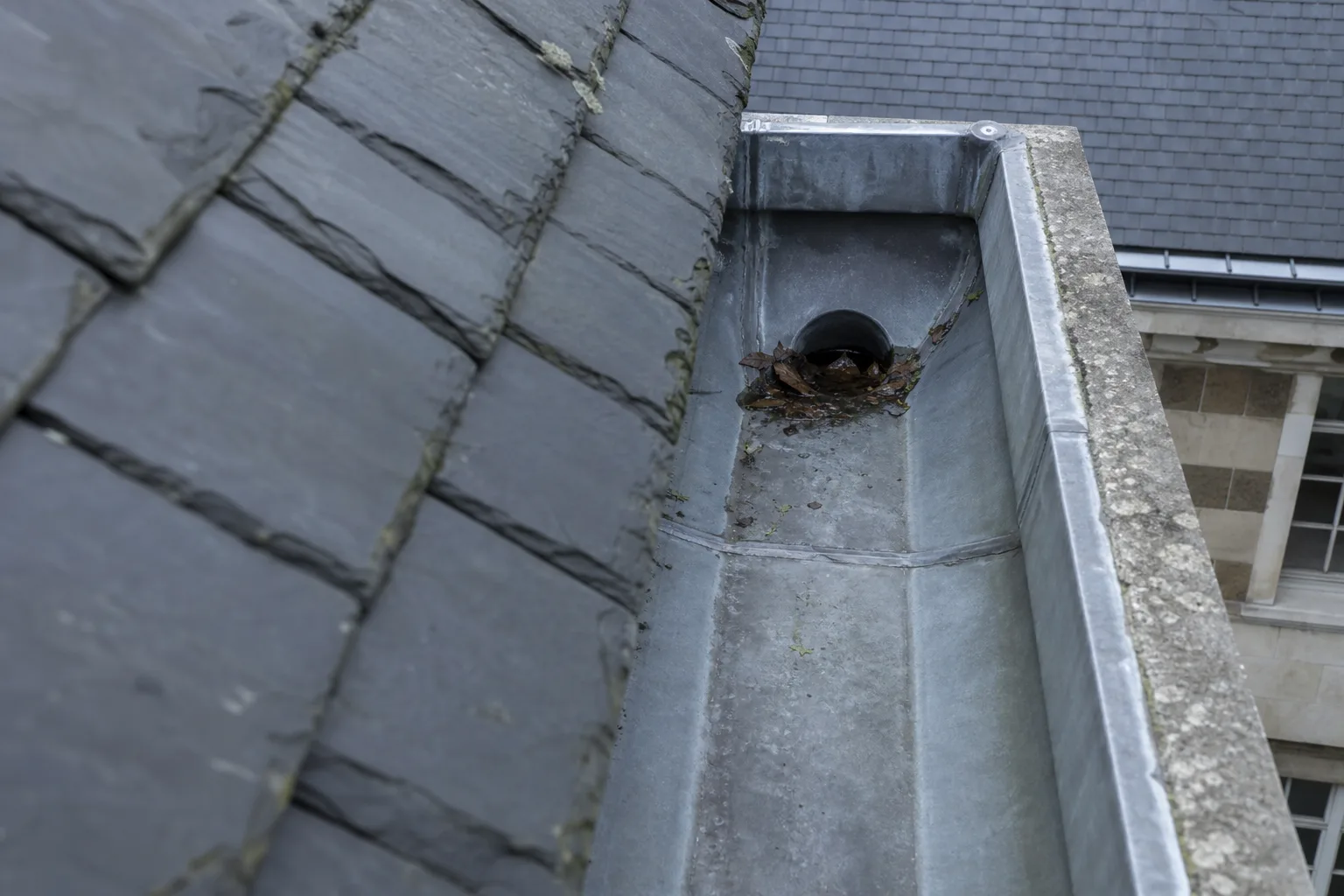
Most houses built before about 1930 with any pretension to a roofline have a gutter you cannot see from the sidewalk. It sits inside the roof structure, behind a raised edge, running along a wood trough that was lined with metal and soldered at the seams. Builders called it a box gutter or a pole gutter depending on how it was framed, and it was normal, not a luxury. It is also the single detail on an old house where a routine cleaning appointment and a five-figure repair sit closest together, separated mostly by who climbed up there and what they did with their hands.
What was normal when it went up, and what has been done since
The original lining was almost always sheet metal, terne-coated steel or copper depending on the budget of the house, laid in sections with lapped and soldered joints and a slight fall toward an outlet. Soldered metal moves. That was understood, and the detailing allowed for it. What has usually happened in the century since is a sequence of cheaper repairs: a coat of fibered asphalt in the 1960s, a rubber membrane cut in during a roof replacement, a bead of sealant at every outlet, sometimes all three stacked on top of each other. The current surface is rarely the original one, and it rarely behaves like it.
That layering matters more than the debris does. Asphalt coatings go brittle and craze; membrane laid over an irregular wood trough tents and traps water underneath; sealant at the outlet fails from below where nobody looks. A gutter in this condition can hold water for a week without a drop appearing indoors, because the leak drains into the wall cavity or along a rafter tail and shows up two winters later as a soft spot in the soffit or paint failure on one specific interior corner. By then the trough boards themselves are usually part of the job.
The assumption, and what is actually true
The common assumption is that gutter cleaning is unskilled labor priced by inconvenience: how tall the house is, how many stories the ladder has to span, how much rot has fallen into the trough. On a hung aluminum gutter screwed to a fascia board, that assumption is roughly correct, and paying someone is mostly about not standing on a ladder yourself. On a built-in gutter it is wrong in a way that costs money. The cleaning is not the product. The cleaning is the access, and what you are actually buying is a trained look at a concealed assembly on the one day of the year it is empty and visible.
The second half of that is the risk side. A pressure washer aimed at a seventy-year-old asphalt coating will strip it and open the seam underneath. A trowel or a stiff putty knife dragged along a soldered lap will break the solder. A shop vacuum hose worked hard at an outlet will pull the sealant plug out of a downspout head. Every one of those is a normal, competent motion in ordinary gutter work and a destructive one here, which is why the distinction between crews is not about care in the abstract but about knowing which surface is underfoot.
What the person up there should be reporting back
Ask for findings in writing before you hire, and judge the answer when it arrives. A useful report names the lining material and its apparent age, describes the condition of the seams and the outlets specifically rather than the gutter generally, notes whether water stands anywhere after flushing and how long it takes to clear, and flags any spot where the lining has separated from the trough wall. Photographs of the outlets are worth more than photographs of the run. If what comes back is a picture of a bag of leaves, you bought leaf removal, which was available cheaper.
Fall protection is the other line item you are paying for whether it is itemized or not. Work at height on a residential roof edge is governed by the Occupational Safety and Health Administration, which is responsible for the rules that decide whether a crew ties off, uses anchors, or works from staging. A contractor who prices anchor points and setup into a built-in gutter job is not padding the quote; that is the cost of doing the work in a way that lets someone move slowly along the trough instead of leaning out from a ladder and rushing.
Where the money goes, and when
Price on this job varies with roof pitch, height, access, and the length of the run, so a quoted range means little without those four facts attached. What is stable is the shape of the spending: a modest recurring cost twice a year, in late fall after the leaves are down and again in spring after the freeze cycles have worked on the seams, against a repair that involves opening the roof edge, replacing wet trough boards, and relining. The recurring cost is small enough to schedule and forget. The repair is not, and it arrives on its own timetable.
The practical decision is narrower than it looks. You are choosing between a crew that treats the trough as a container to be emptied and one that treats it as a roof surface to be inspected, and the second kind will tell you which lining you have before quoting. Ask that question first. The answer sorts the field faster than three estimates will.