Deposit Withheld? What Solid Evidence Costs to Build, and What Weak Evidence Costs to Lose
A renter's guide to the two piles of evidence in a landlord dispute, what each one costs to assemble, and which cheap habits carry the most weight.
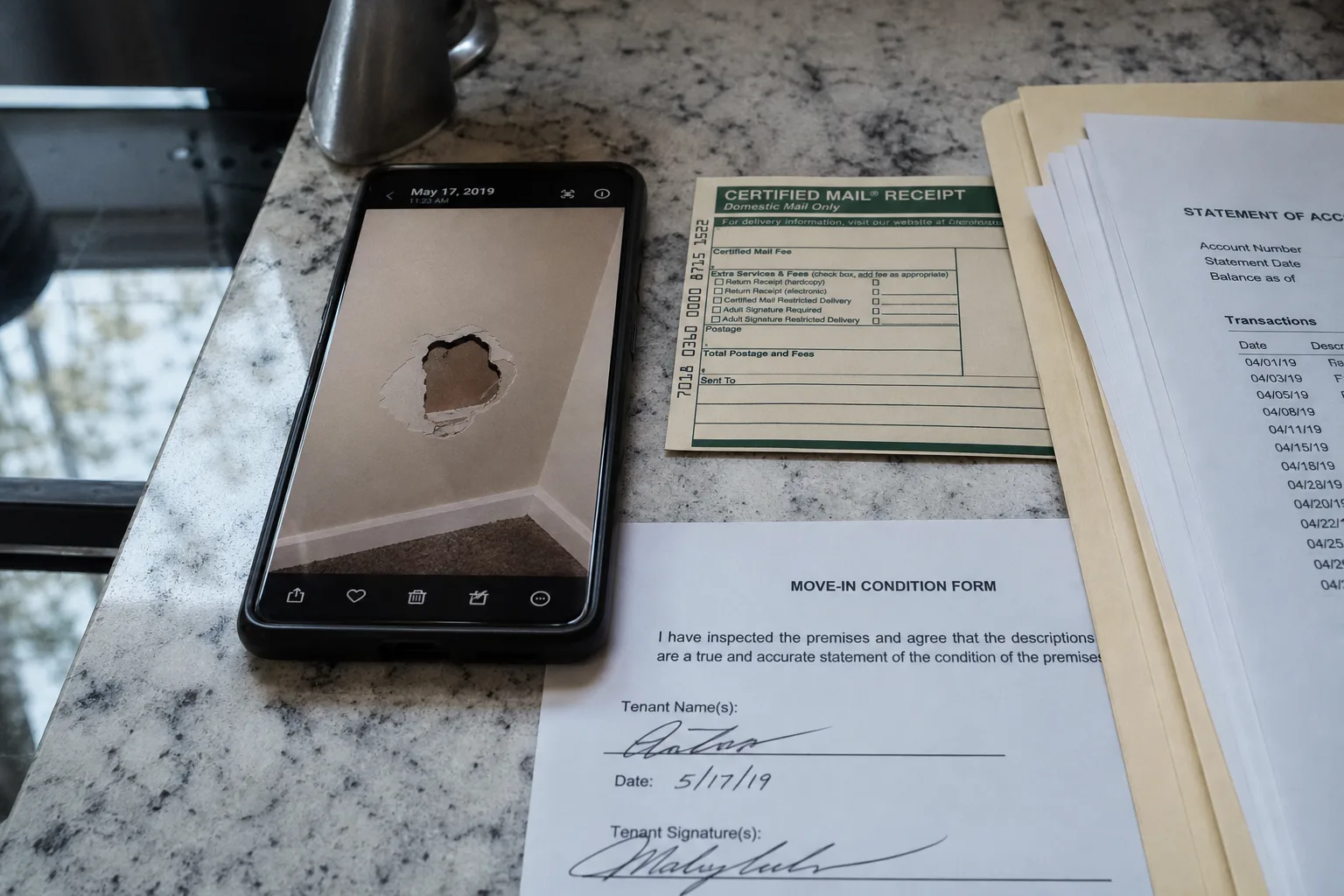
After enough of these, you stop asking whether a tenant is right and start asking what they can show. The answer is usually a phone full of photographs with no dates, a memory of a conversation in a stairwell, and a strong sense of unfairness. None of that is worthless, but it sits in a different pile from a dated repair request, a canceled check, and a move-in condition form signed by both parties. The gap between those two piles is where deposits are lost. The gap is also cheaper to close than most renters assume.
The first pile can be checked by someone else, the second cannot
Evidence that holds up shares one property: a neutral third party can verify it without believing you. A certified mail receipt has a tracking number the postal system generated. A bank statement showing a rent debit has a date the bank set, not one you typed. A text message thread has a timestamp on both handsets. Evidence that does not hold up depends on your account being accepted: undated photographs, a summary of what the superintendent said, a repair you describe as urgent without anything showing you reported it. Same facts, different weight.
The practical test I use before a filing is simple. For each item, ask who besides you could confirm it exists and when it was created. If the answer is a bank, a carrier, a licensed inspector, a utility, or a second person on the other end of a message, the item belongs in the strong pile. If the answer is only you, it belongs in the supporting pile, where it explains context but decides nothing. Most disputes turn on three or four items in the first pile, not on volume.
What the strong pile costs to assemble
Less than people fear, and most of it is time rather than money. Photographs are free if you take them with location and date settings on and move them off the phone the same week. A written repair request costs nothing if it goes by email or through a portal that keeps a record. Certified mail with return receipt costs a few dollars per letter at the post office counter, and it is the single cheapest thing a renter can buy in a dispute. Bank and card statements are already generated for you.
Costs climb only when you need someone with credentials. A licensed plumber or electrician writing up a condition in plain language typically charges a service call fee, the same one they would charge for a visit that fixed nothing. An independent mold or air quality assessment runs materially higher, into the hundreds, because it involves sampling and a lab. A local code inspection is often free to request, because the housing agency already has the inspector on payroll. The Department of Housing and Urban Development oversees federal housing programs and fair housing complaints, and enforcement at the building level generally sits with your city or county inspector.
Where the money actually goes when the evidence is thin
Thin evidence rarely produces a dramatic loss. It produces a settlement at forty cents on the dollar, and a day off work to get there. Count the real line items: the small claims filing fee, service of process if the court requires it, the lost shift, sometimes a second lost shift for an adjourned date, and the portion of the deposit you concede because you cannot prove the stain was there when you moved in. That total commonly exceeds what the strong pile would have cost to build during tenancy, and it arrives all at once.
The other cost is leverage before anyone files. A landlord who receives a letter attached to dated photographs, a copy of the signed move-in form, and a repair request sent eleven months earlier tends to answer differently than one who receives a paragraph of grievance. In my experience that letter resolves more matters than any hearing does, and it resolves them at the price of postage. Evidence bought cheaply and early is mostly a way of never needing the courthouse at all.
The four habits that carry the weight
Document the unit within seventy-two hours of getting keys, room by room, including closet floors, window tracks, appliance interiors, and anything already broken, then email the set to yourself so a server timestamps it. Put every request in writing, even one you already made in person, with a one-line reference to the conversation. Pay rent in a way that generates a record, and keep the record rather than the receipt. Ask for the written condition form at move-in and again at move-out, and keep a copy signed by whoever inspected.
Those four habits produce the pile that a judge, a mediator, or a reasonable property manager can check independently, and they cost roughly one evening at move-in plus a few minutes per incident afterward. Everything else, the neighbor who remembers the smell, the photograph with no date, the recollection of a promise, becomes useful once the verifiable items are already in place.
The renters who recover full deposits are not the ones with the worst landlords or the best arguments. They are the ones who spent a small amount of attention early, on records someone else generated, and never had to reconstruct a year afterward from memory.