Doors That Stick and Plaster That Powders? The Forty-Eight Hours Those Bills Trace Back To
Most of what water damage costs a house shows up months later, in doors, plaster and floors, and the drying record from day one is what settles who pays.
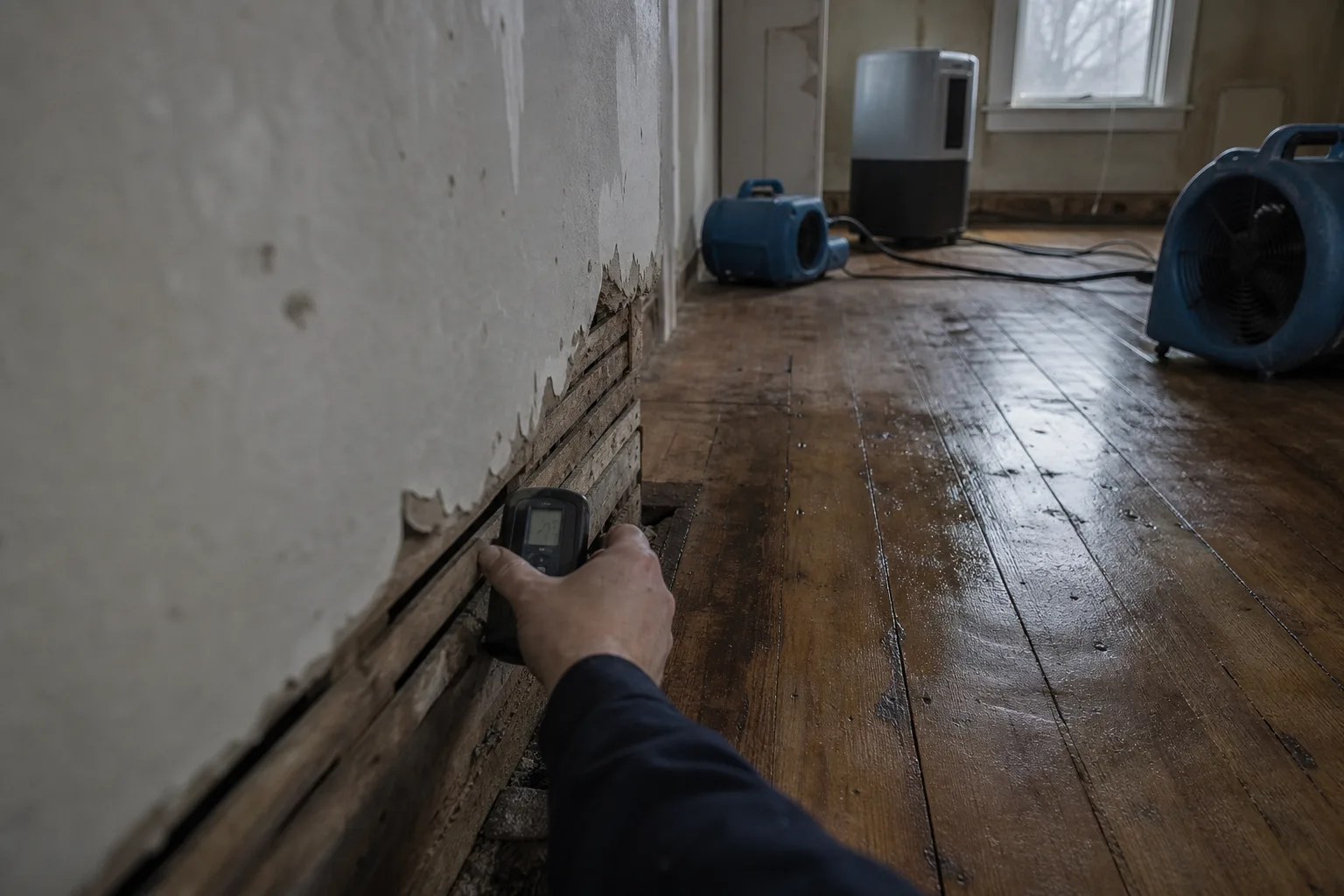
A door that sticks in February is rarely a door problem. In houses that took water the previous spring, it is usually a jamb that moved while the framing behind it gave up moisture slowly, over months, long after the equipment left and the file closed. The same delay explains paint that lifts in a band a foot off the floor, a closet that smells only in humid weather, and a wide-board floor that cupped, flattened, and then cupped again. None of it looks like water damage by the time it appears. All of it was decided in the first two days.
The consequences arrive on a lag, and the house does not label them
Structural wood in an old house holds moisture the way a sponge holds it, unevenly and for a long time. Surfaces read dry within a week because surfaces always do; the sill, the joist ends and the bottom eighteen inches of studs can sit well above normal for a season. As they release that moisture into a heated house in winter, framing shrinks, fasteners loosen, and joints that were tight in August open in January. Plaster keys that softened behind the lath crumble quietly and the coat lets go later, under its own weight, in a patch that has no obvious cause.
Then there is the work that gets built over damp material. A floor laid in October on a subfloor still carrying moisture will telegraph it by spring, and most manufacturer warranties exclude installation over a substrate above a stated moisture content, which is why the installer asks for a reading and writes it down. Trim reinstalled early splits at the miters. Cabinet toe kicks swell. The repairs are individually small, three or four hundred dollars apiece, and collectively they can exceed what a longer drying schedule would have cost when the equipment was already in the house and running.
What a national restoration provider is actually producing while it works
When the mitigation crew belongs to a large franchise or a contractor working inside an insurer's managed repair program, the visit generates a documented record whether or not anyone hands you a copy. That record typically includes an initial moisture map of affected rooms, readings taken on defined materials, a comparison reading from an unaffected area of the same material, a stated drying goal, a daily log of readings and equipment placement, and a final set of numbers used to declare the structure dry. The scope of repairs is then written in standardized line items that the carrier's estimating software recognizes.
That standardization is genuinely useful, and it is the part homeowners underuse. A large provider has to defend its numbers to an adjuster, so the numbers exist, dated and attributed, in a form that survives a change of personnel. Ask for the drying log and the final readings at the moment the equipment comes out, not six months later when a floor has cupped and the file has been archived. The Environmental Protection Agency is responsible for federal guidance on indoor moisture and mold, and the vocabulary in that guidance is the vocabulary the provider's paperwork already speaks.
An older house does not dry the way the standard scope assumes
Plaster on wood lath, wide-board subfloor over sawn joists, and a masonry foundation with no capillary break underneath were normal when the house went up, and none of them behave like drywall over engineered lumber. Lath holds water between the boards where no meter reaches. A balloon-framed wall carries water from a second-floor supply line down an uninterrupted cavity to the sill, so the wet room and the damaged room are two floors apart. Old-growth flooring is denser than anything milled today and gives moisture up more slowly, which reads as stubborn on a drying log and as normal to anyone who works on these buildings.
What has been done since matters just as much. Vinyl sheet glued over original boards, spray foam at the rim joists, a poly vapor barrier added during a nineties remodel, paneling over plaster: each one is a layer that traps water on the wrong side and hides the reading. Say all of this out loud on day one, to the crew chief and again to the adjuster, because it changes the drying plan from a three-day default to something the building can actually meet. A provider with a national protocol has an escalation path for atypical assemblies, and this is the moment to put the house on it.
What to ask for while the fans are still running
Ask for the readings in writing every day, with the material and location named, not a verbal assurance that things look good. Ask what number counts as dry for this house, and where the comparison reading was taken, because a dry standard borrowed from a different assembly is the most common reason a file closes early. Ask for photographs behind removed baseboard and inside opened cavities before anything is closed up. Ask that reinstallation of flooring, trim and cabinetry be held until the subfloor meets the installer's own stated moisture threshold, and get that threshold from the installer rather than from the mitigation crew.
Ask, finally, about the supplement. If additional damage appears after the initial scope is written, the repair contractor submits a supplement to the carrier, and there is a practical window in which that is routine rather than a fight. Knowing who submits it, and by when, is worth more than any single reading. Keep the drying log with the claim documents, because a buyer's inspector will eventually ask about the stain on the joist, and a dated record showing the material was dried to a standard answers the question in one page instead of reopening it.
The houses that come through this well are not the ones that dried fastest. They are the ones where somebody wrote down what was wet, how wet, on what date, and what number it had to reach before the trim went back, and then kept that paper. Six months on, when the door sticks, that file turns a mystery into a measurement, and a measurement is something a carrier, a contractor and a buyer can all read the same way.