Every Password You Own Has a Second Owner. What the Site Does With It Decides More Than You Do
The advice about passwords changed because the burden moved to the party most people never think about: the service storing the credential and controlling the reset path.
Old houses carry the assumptions of the year they were framed, and so do password rules. The habits most people still practice, eight characters with a capital and a digit and a symbol, changed every quarter, were built for a computing environment that no longer exists: a single institutional system, a small number of accounts per person, an attacker who had to guess at a login prompt rather than download a stolen file and work on it offline. The rules made sense inside those constraints. What has been done to the building since is the interesting part, and most of the work happened on a side of the transaction the account holder never sees.
What the original rules were designed to hold up
Complexity requirements and forced rotation both answer the same threat model, which is a person sitting at a terminal trying passwords one at a time against a live system. Under that model, adding character classes multiplies the guesses required, and expiring the credential every ninety days limits how long a compromise stays useful. Neither assumption survives contact with the modern pattern, in which credentials leak in bulk from a breached database and are cracked at leisure on hardware built for the purpose. The National Institute of Standards and Technology is the body responsible for federal digital identity guidance, and the direction of that guidance has moved steadily toward length, uniqueness, and screening against known-compromised credentials rather than composition rules and calendars.
The behavioral evidence pushed the same way. Complexity rules produce predictable output, because people satisfy them the cheapest way available: capitalize the first letter, append a digit, append an exclamation point. Forced rotation produces a documented pattern too, the incremented suffix, which converts one memorized secret into a series an attacker can extrapolate from a single leak. So the advice changed, and the change was not a softening. It moved effort away from the account holder, who cannot do much about how a company stores things, and toward the party that can.
The party nobody negotiates with
Your password has two owners. You choose it and remember it, and the service you gave it to has to store something derived from it, check it on every login, and decide what happens when it is submitted a thousand times in an hour. That second owner, the verifier, determines whether your twenty-character passphrase was worth the trouble. If the credential was stored with a slow, salted, purpose-built hash, a stolen database is expensive to attack and long passwords buy real time. If it was stored with a fast general-purpose hash, or in plain text, the length of your password stops being the variable that matters. You are not consulted on that decision, and it is rarely disclosed.
The other half of the verifier's job is rate limiting and detection. A login page that accepts unlimited attempts against the same account, or the same password against thousands of accounts, hands an attacker the cheapest possible route in. Screening new passwords against lists of previously breached credentials is now standard practice among serious providers, as is monitoring for the pattern where one leaked password is tried across a whole user base. Where that work is done well, the account holder's job gets simpler and the returns on a long unique password get larger. Where it is not, the reset path is usually the softer target anyway.
The reset path is the real front door
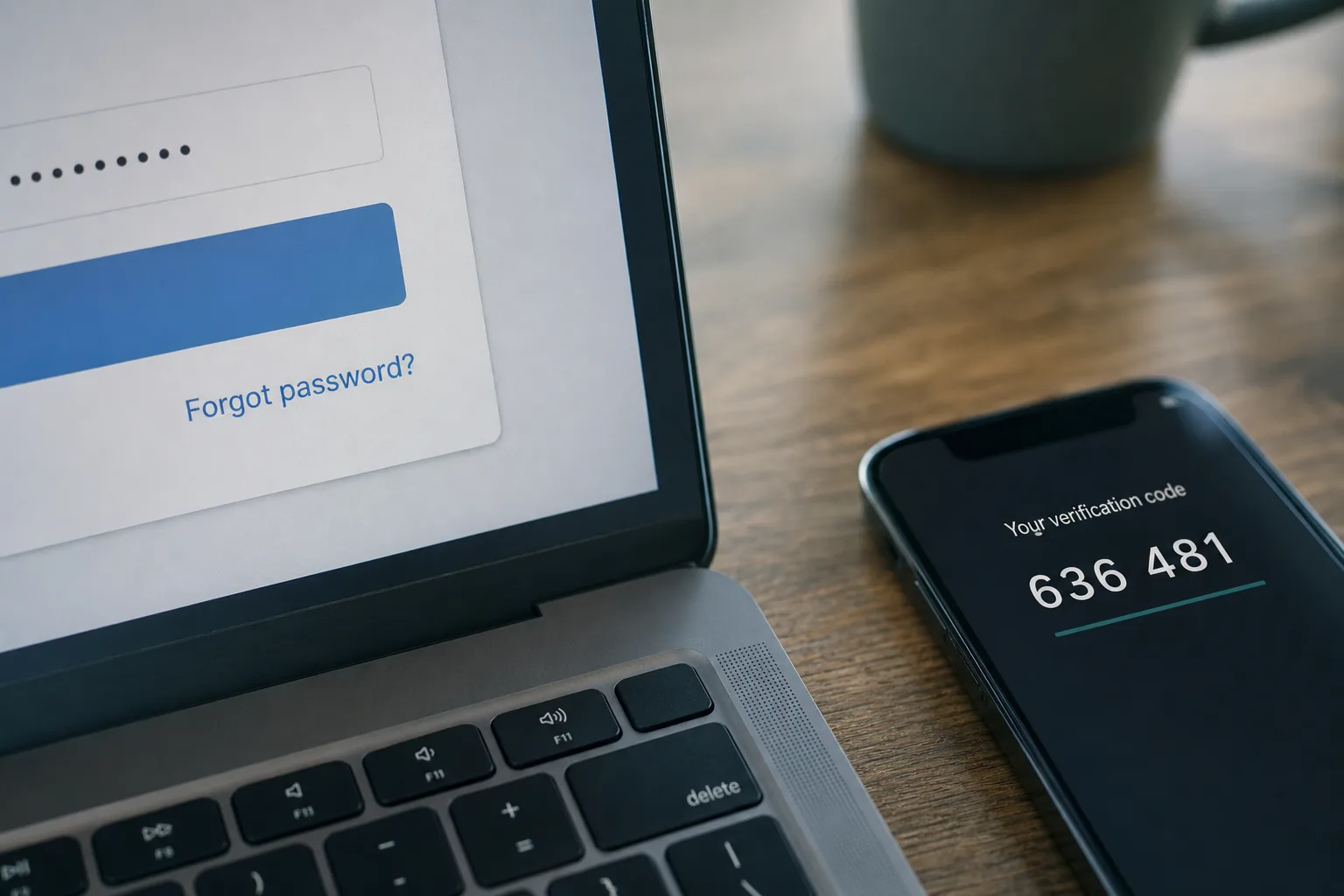
Every account you hold has a second entrance, and it is the one labeled forgot password. That entrance almost always leads to an email inbox, sometimes to a phone number, occasionally to a support agent with the authority to override both. Which means the strength of dozens of accounts collapses into the strength of one or two: whichever mailbox receives the reset links, and whichever phone line receives the codes. A carrier employee who is talked into moving a number to a new SIM has, in that moment, more control over your bank login than your password does. A support representative who accepts a plausible story and a partial account number has the same.
This is why the practical advice reorganized itself around the recovery layer rather than around the credential. Protect the mailbox first, with a long unique password and a second factor that is not a text message, because a phone-based code inherits the weaknesses of the carrier's own customer service desk. Use an authenticator app or a hardware key where the option exists. Review the recovery addresses and phone numbers already on file for your important accounts, since stale entries, an old work address, a number you gave up years ago, are entrances you have stopped watching. Fixing that list takes an afternoon and closes a gap no password choice can reach.
What the current advice asks of you, and what it does not
The short version of the modern guidance is that length beats decoration, uniqueness beats memorability, and rotation should follow evidence rather than the calendar. You change a password when there is reason to believe it was exposed, not because a quarter turned over. You stop trying to remember dozens of distinct secrets, because that constraint is what produced reuse in the first place, and you hand the remembering to a manager, whether a paid one, the one built into your browser, or in some households a notebook kept somewhere sensible. What you keep in your own head is the small set that unlocks everything else.
Passkeys are the next stage of the same shift, and they are worth understanding as a change in who holds what. Instead of a shared secret that both you and the site store, your device keeps a private key it never transmits and the site keeps only the public half. A breach of the site's records yields nothing an attacker can replay, and there is no password to phish. Adoption is uneven, so the practical position for now is mixed: passkeys where they are offered on accounts that matter, long unique passwords in a manager everywhere else, and second factors on the mailbox that governs both.
Read the guidance that changed as a reallocation of work rather than a relaxation of standards. Most of the burden moved to the companies holding the credentials, where the leverage always was, and the part left with you is narrower and more durable: a small number of well-protected entrances, and a clear-eyed view of who else can open them.