Filing a Claim After Your Neighbor's Tree Came Down? How to Keep the Next Renewal Clean
Claims history now drives renewal pricing more directly than it used to. The paperwork you assemble before you call decides how a loss reads three years later.
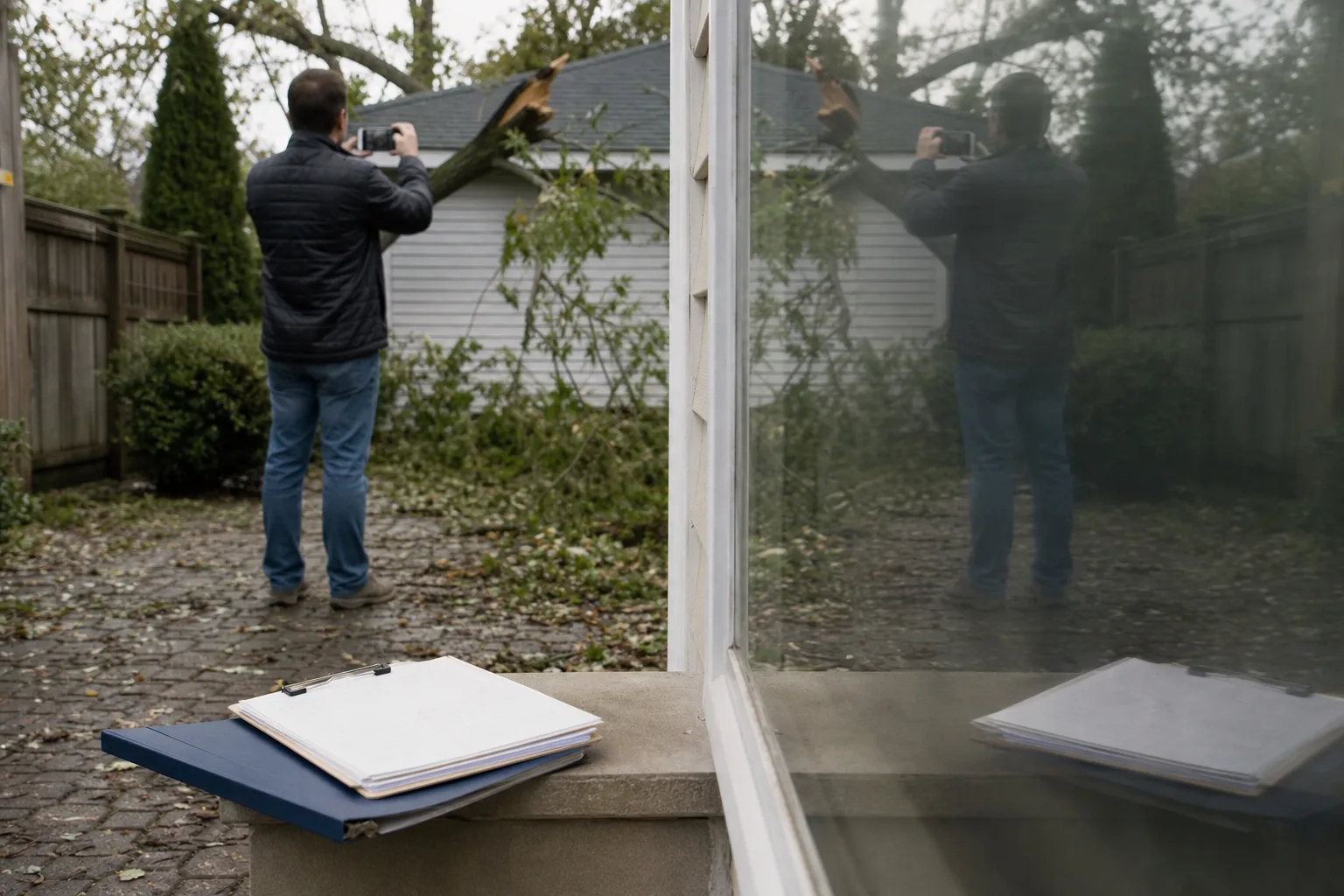
A limb from the maple two doors down lands on your garage roof in a March wind, and within an hour you are holding a phone, a flashlight and a decision that will still be visible on your policy in 2029. The question is not whether to report the damage. It is what you report, when, with what attached, and whether the conversation you are about to have counts as a claim at all. Underwriting has become noticeably more mechanical about prior losses in the past few years, which cuts both ways: the criteria are harsher, but they are also more legible, and a legible rule can be worked with.
What changed at renewal, and why it now reaches back further
Two shifts matter. Carriers have moved a great deal of property inspection to aerial and satellite imagery, so the condition of your roof at renewal is frequently assessed without anyone driving down your street, and a tarp photographed from above is a data point whether or not you ever filed. At the same time, prior-loss history is being read with less discretion than it used to be, and water losses in particular are treated as predictive of the next water loss rather than as bad luck. The practical result is that a small claim now buys a smaller repair and a longer shadow.
That shadow has a known shape. Most personal lines carriers pull a claims history report on new business and, in many cases, at renewal, drawing on an industry-wide loss database that records reported losses across carriers. Under federal fair credit reporting rules, which the Federal Trade Commission is responsible for enforcing, that report is a consumer report about you, and you are entitled to see it and to dispute what is wrong in it. Ordering your own copy before you need it is the single cheapest piece of preparation available, because errors on it are common enough to be worth checking and slow enough to fix that you do not want to discover one mid-claim.
The difference between asking a question and filing a claim
When you call your agent to ask whether a fallen limb and a dented gutter are worth pursuing, you may be having a conversation or you may be creating a record, and the difference depends on the carrier, the state, and the exact words used. Some carriers log every contact as an inquiry, some log only losses reported with a date and description, and a number of states now restrict what an insurer may do with an inquiry that never became a paid claim. None of this is uniform, so the useful move is to ask the question directly at the top of the call: is this being opened as a claim, and if I decide not to proceed, what stays on the file?
Ask it plainly and write down the answer with the date, the name of the person, and the reference number if one is generated. If you would rather not test the question at all, price the repair independently first. A contractor's written estimate costs you nothing at most residential firms, tells you whether the number clears your deductible with enough margin to be worth the filing, and gives you a document you can hand to an adjuster later if you change your mind. Estimates do not appear in any claims database. That asymmetry is the whole reason to get one before you dial.
The file to build in the first two days
Photographs are worth more when they are boring and numerous. Shoot wide first so the location is obvious, then close, then shoot the undamaged sections of the same roof or wall for comparison, and leave the timestamp and location metadata intact rather than editing the images or sending them through a service that strips it. Add a short written log kept in one place, a notes file or a paper pad, recording each call, each visit, each time the tarp was checked. If the loss originates next door, photograph the source too: the split trunk, the redirected downspout, the failed section of shared fence, dated and in daylight.
Then collect the documents that describe your coverage before anyone describes it to you. That means the declarations page, the full policy form rather than the summary, the endorsements, and any roof settlement schedule attached in the last renewal cycle, because those schedules have quietly changed on many policies and now pay depreciated value on older roofs where they once paid replacement cost. Reading the deductible line matters as much as the coverage line. A percentage wind deductible on a two hundred thousand dollar dwelling limit is a different number from the flat figure people remember, and it decides whether the claim is worth opening.
Subrogation, and the letter that lands on your neighbor's mat
Here is the part households routinely do not see coming. If your carrier pays for damage caused by something on a neighbor's property, and it believes that neighbor was negligent, it may pursue their insurer for reimbursement, and it does not need your permission or your enthusiasm to do so. The first your neighbor hears of it is often a letter from a company they have never dealt with, referencing a loss they thought had been handled between the two of you. That letter, arriving cold, has ended more good fences than the fences ever caused.
Prevent it with a sentence, said early and in person. Tell the neighbor you are reporting the damage, that your insurer may contact theirs, and that this is procedure rather than an accusation. Then tell your adjuster, in writing, what the relationship is and what you have agreed between yourselves, because that note goes in the file and shapes how the recovery unit approaches it. A successful subrogation also tends to change how the loss is coded on your own history, since a claim recovered in full reads differently from one paid outright. That is a real benefit and it is worth asking about by name.
Reading the renewal that follows
When the renewal arrives, compare it against last year's declarations page line by line rather than against the total premium, because the increase is often sitting in a changed deductible, a dropped discount, or a coverage limit that quietly moved. If a claim-free discount has come off, ask how many years restore it. Carriers publish that internally and agents can usually tell you. Knowing the number turns a vague penalty into a date, and a date is something you can plan a roof replacement around.
Keep the file after the check clears. Three years on, when an underwriter asks what the 2026 loss was, the household that can answer in one email with photographs and a repair invoice attached is the household that gets the benefit of the doubt.