Hiring an expert over a shared boundary? The neighbor you didn't hire decides the outcome
When you retain a surveyor, engineer or arborist for a line dispute, the neighbor you never hired controls access, consent and whether the finding ever settles anything.
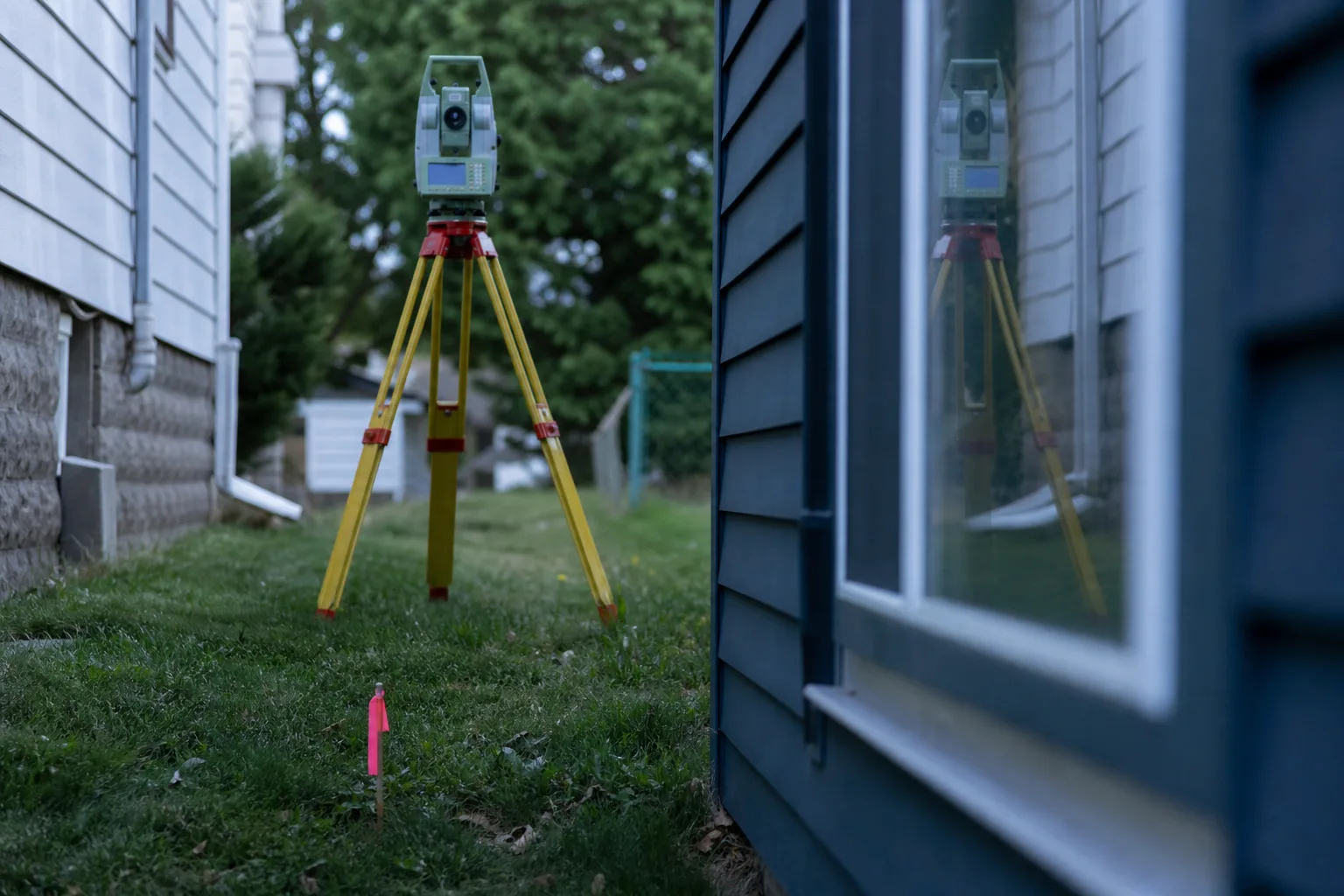
Most people retain a surveyor, an engineer or a certified arborist the way they buy a plane ticket: pick a price, pick a date, assume the product is standardized. It is not. Two licensed professionals can look at the same strip of ground between two houses and produce documents that differ in what they measure, what they refuse to opine on, and whether the result will hold up when the person on the other side of the line reads it. The difference is rarely visible in the quote. It becomes visible about six weeks later, when you need the finding to do something.
The person you did not hire is standing in the transaction anyway
A boundary survey, a party wall assessment, a drainage study, a tree risk evaluation: each of these involves a piece of ground or structure that at least two households have an interest in. You are the client. Your neighbor is not, and never signed anything, and owes your expert nothing. Yet that neighbor controls whether the crew can set foot on the far side to recover a monument, whether an engineer can see the other face of a wall, and whether the finished report is treated as a fact or as something your side paid for. Overlook that party and you have bought a document with a hole in it.
This shapes what competence looks like. The professional worth hiring asks about the neighbor early, sometimes in the first ten minutes, because it changes the method. Can we get access, and if not, what can be established from your side alone, and how much does that weaken the conclusion? Someone who never raises the question is either planning to work around it quietly or has not thought about the second household at all. Both are expensive. The version of the work that survives contact with the other side costs a little more up front and settles far more.
Fluency is easy to produce and hard to distinguish from judgment
Plausible sounds like confidence delivered fast. It answers the question you asked in the words you used, quotes a number without a range, and moves toward signature. Good sounds slower and slightly less satisfying. It restates the problem in different terms than you offered, separates what can be measured from what has to be argued, and names the point at which the answer stops being technical and starts being legal. That reframing is the single most reliable signal available to a layperson, because it cannot be faked by someone who does not actually understand where the boundaries of their own discipline sit.
Watch how limits get described. A surveyor who explains that a retracement of an old subdivision depends on which monuments still exist, and that two competent surveyors can reach slightly different lines from the same imperfect record, is telling you something true about the trade. Measurement traceability in this country runs back to standards work overseen by the National Institute of Standards and Technology, but a legal boundary is not only a measurement; it is a measurement laid over a documentary history. Anyone who presents it as pure arithmetic is selling you certainty they do not have.
Questions that separate the two, asked before money changes hands
Ask what the deliverable will be, in nouns. A sketch, a stamped drawing, a written opinion, a report suitable for filing with the county, and testimony if the matter goes further are five different products at five different prices, and clients routinely believe they bought the fourth when the engagement letter describes the first. Ask what happens if the neighbor refuses access, and whether the fee changes. Ask who else the professional has worked for on this block or in this subdivision, because prior work for the other household is not disqualifying but is something you want to hear from them rather than discover later.
Then ask the question people skip: what would make you tell me I do not have a case here. A professional with judgment has an answer ready, usually a specific one involving a recorded easement, a period of open use, or a document that would settle the matter without further fieldwork. Someone who cannot describe the conditions under which their own work would go against you is, functionally, an advocate you are paying by the hour. Advocates have their place. You just want to know which one you have retained before you rely on the result.
Buying the version that the other household can read
Reports written only for the client tend to be adversarial in tone, which makes them useless as a way of ending an argument. The more valuable document is neutral on its face: it states the method, cites the records consulted, shows what was found in the field, and lets the conclusion follow. When your neighbor's own professional reads it, the question becomes whether the method was sound rather than whether you hired someone agreeable. That is the difference between a report that opens a conversation and one that hardens a position, and it is worth saying out loud to the person you retain.
There is a practical version of this that costs almost nothing. Tell the neighbor a survey is happening, the date, and roughly what the crew will do, before the truck arrives. Offer to share the result whether or not it helps you. Most disputes over lines and walls are not really disputes about geometry; they are disputes about being surprised. A professional who understands that will time the work accordingly, and will often write in a way that gives the other household somewhere to stand. That is the mark of expertise applied to the situation rather than to the file.
The judgment you are building is not technical. You are not going to out-survey a surveyor. You are learning to hear whether someone has accounted for every party the work touches, including the one who never signed the check, and to prefer the professional whose answers get more specific under pressure rather than smoother.