Logged Into the Gradebook Every Night? What the Portal Changed and Where the Line Sits
Nightly grade portals, parent logins and tutoring contracts changed what supporting a student's study looks like, and where a parent's access actually stops.
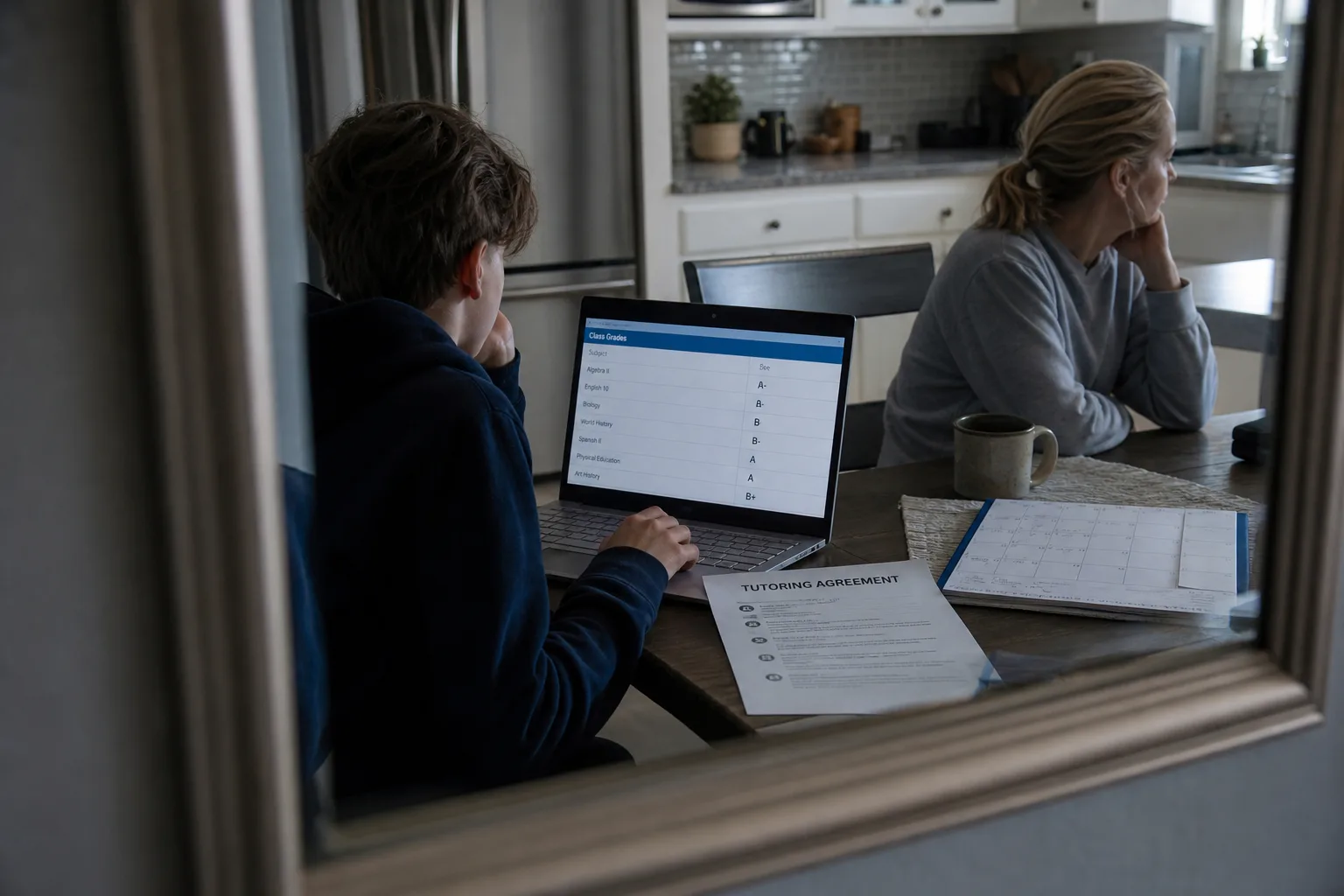
The paperwork that governs how a parent supports a student's work is mostly invisible until something goes wrong: a login that stops working in September, a tutoring agreement that names the student rather than the payer, a grade that appears on a Tuesday night and is corrected on a Thursday. None of this was designed as a single system. It accumulated, one district decision and one vendor contract at a time, and it now sets the practical boundary between helping and taking over far more firmly than any family rule does.
The report card became a feed, and the question changed with it
For most of the last century, a parent learned how school was going four times a year, in an envelope, after the fact. The grade was a summary, and the only available response was a conversation. Student information systems changed the unit of information rather than the amount of it: a parent now sees individual assignments, late flags, and running averages that move whenever a teacher enters something. The shape of the parental question changed accordingly, from how is the semester going to why is there a zero on last Thursday's warm-up, which is a question a thirteen-year-old is better placed to answer than you are.
That shift matters because the nightly feed invites a nightly intervention, and nightly intervention is what crosses the line from support into ownership. The entries are also provisional in a way the old report card never was. Teachers enter placeholder zeros for ungraded work, correct transcription errors in batches, and sometimes leave a unit unposted for a week while they grade it. A parent reading the feed as finished information will raise alarms that resolve themselves, and will spend credibility doing it.
What the login actually entitles you to
The parent account is not a courtesy and it is not unlimited. Federal student privacy law gives parents the right to inspect and review their child's education records and to ask that inaccurate records be amended, and the Department of Education is the agency responsible for administering those protections and handling complaints when a school does not honor them. That is a right of access and correction. It is not a right to direct instruction, to require a particular grade, or to receive a teacher's unrecorded impressions on demand.
The detail that surprises families most arrives at eighteen, or earlier at a college, when those rights transfer to the student. A parent who has been reading a portal for six years does not automatically keep reading it, and a college will generally require the student's written authorization before discussing grades, conduct, or an academic standing letter. Families who treat the transfer as a scheduled event rather than a shock tend to handle it well: they talk about what will be shared voluntarily, and they sign the release, or decline to, on purpose.
Who the tutoring contract says the client is
Paid tutoring has moved from a kitchen-table arrangement to a documented one, with intake forms, cancellation windows, progress reporting, and, for online services, terms of use that run to several pages. Read the engagement for one specific thing before you read anything else: whether the tutor's reporting obligation runs to you, to the student, or to both, and in what detail. Plenty of good tutors will tell you attendance and effort while keeping the content of a session with a high schooler reasonably private, and they will say so in writing if asked at the start.
The second thing worth settling in the agreement is scope, because scope is where support turns into substitution. A tutor who completes problem sets produces a student who tests badly, and most school honor codes reach outsourced work regardless of who paid for it. Agreements that specify review, practice, and instruction, rather than assistance with graded submissions, protect the tutor and the student at once. Ask also about the cancellation window, the makeup policy, and whether unused prepaid hours expire, since those three terms determine almost all of the disputes that ever arise.
The standing appointment holds a boundary that willpower does not
The households that manage this best usually do the same unglamorous thing: they convert monitoring into a scheduled, announced, limited event. A set time on Sunday to look at the portal together, with the student driving, replaces six unprompted check-ins a week and produces better information, because the student is explaining rather than defending. The portal's notification settings exist to support exactly this, and most systems let you choose a weekly summary instead of an alert for every entry.
The same logic applies to a teacher. An email that asks a specific, answerable question, sent once and given a few business days, gets a better answer than three messages in an evening. Keep what you are told, note the date, and bring it to the next conference rather than relitigating it in between. Families who hold that rhythm find that the student starts bringing problems forward unprompted, which is the whole point of the arrangement.
The system you are working inside was assembled for administrative reasons, not pedagogical ones, and it hands parents more raw information than any previous generation received. Deciding in advance how much of it you will look at, how often, and with whom is the decision that keeps the help genuinely helpful.