Your Neighbor Excavated and Your Slab Cracked. What the Earth Movement Exclusion Is Doing There
An exclusion is not an escape hatch. In a boundary excavation claim, it usually tells you which policy is supposed to pay, and how to reach it.
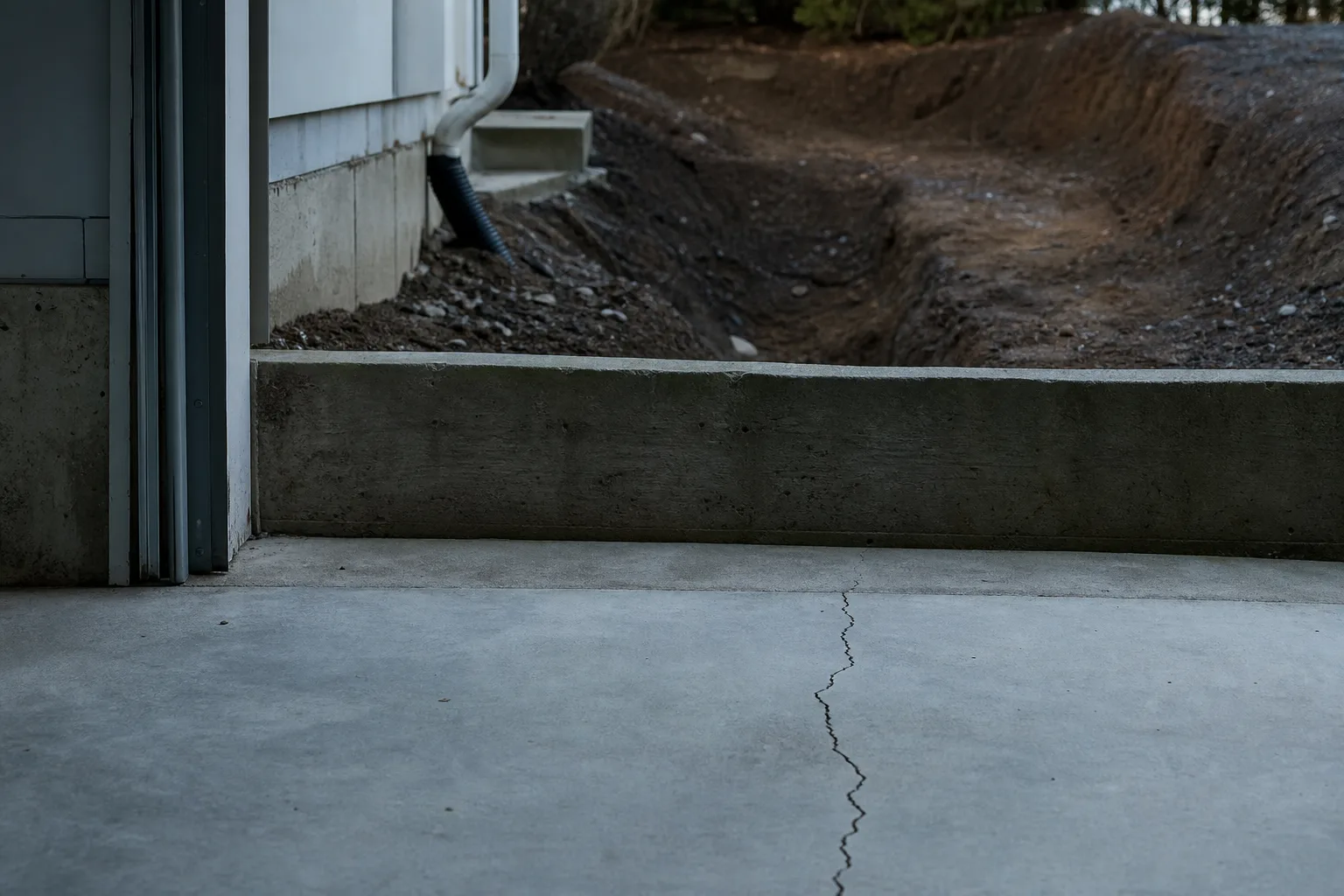
The crack shows up late. A neighbor pulls a permit in April, an excavator works the far side of the property line for two weeks in May, and in July the garage slab opens a hairline that widens to something you can slide a quarter into, with the retaining wall leaning a degree or two off plumb behind it. You call your homeowners carrier because that is what the policy is for. The adjuster comes out, takes photographs, and then says the word earth movement, and the conversation changes temperature. That word is doing a specific job, and it is not the job most people assume.
The assumption is that an exclusion exists to deny you. Mostly it exists to route you
The common reading of an exclusion is adversarial: the insurer wrote a list of ways to say no, buried it on page nineteen, and waits for a claim to reach for it. That reading is understandable and it is largely wrong about function. Exclusions do three things, and denial is only one of them. They remove losses that are not fortuitous, meaning wear, rot, and deferred maintenance, because a policy that covered inevitability would be a savings account with a worse interest rate. They remove catastrophic correlated risks that a single carrier cannot spread across its book. And they remove losses that belong to a different policy entirely.
That third category is the one that matters on a boundary excavation, and it is the one almost nobody recognizes when they hear it. Flood is excluded from essentially every standard homeowners form in the country, not because flood damage is undeserving, but because flood coverage is written separately, through the National Flood Insurance Program that the Federal Emergency Management Agency is responsible for, or through a private flood market that prices it on its own terms. Earthquake sits in a comparable position, available by endorsement or by a stand-alone policy in the states where people buy it. The exclusion is a signpost. It says the money is somewhere else.
What the earth movement clause actually covers, and what it was built around
Read the clause itself before you argue with anyone about it. In most standard forms the earth movement provision sweeps in earthquake, landslide, mudflow, sinkhole collapse, and then the phrases that decide your claim: earth sinking, rising, or shifting, sometimes with the word subsidence, sometimes with settling, cracking, shrinking, bulging, or expansion of pavements, patios, foundations, walls, floors, roofs, or ceilings appearing separately a few lines down. Two different exclusions, both pointed at a cracked slab. The drafting is old and the reasoning behind it is geological rather than legal. Soil moves constantly, everywhere, and a carrier pricing a national book cannot underwrite the specific clay under your garage.
Then find the sentence that governs how those words combine. Many forms carry an anti-concurrent causation lead-in, something close to we do not insure for loss caused directly or indirectly by any of the following, regardless of any other cause or event contributing concurrently or in any sequence. That sentence is why a plain human-cause argument does not automatically win. If earth moved, and the earth moving is what cracked the slab, the presence of a backhoe earlier in the chain does not by itself pull the loss back under your first-party coverage. Knowing that before the call saves you two weeks of the wrong argument.
The loss did not vanish. It moved to the excavator's policy and your neighbor's liability coverage
Here is the part that reframes the exclusion from a wall into a direction sign. A neighbor who excavates near a shared line owes a duty regarding lateral support, and the contractor who did the digging carries commercial general liability insurance precisely because this failure mode is known, common, and foreseeable. Your homeowners policy excludes earth movement as a first-party peril. It does not follow that no insurance responds. It follows that the responding policy is the excavator's, and behind it the neighbor's own homeowners liability coverage, which exists to pay for property damage the insured causes to somebody else. Different policy, different trigger, same repair.
This distinction is worth stating plainly because it changes what you should be collecting. A first-party claim needs proof of damage and proof of cause within a covered peril. A third-party liability claim needs proof of damage, proof of causation, and proof that a specific person's conduct produced it. The second requires a dated record of what happened next door, which permit was pulled, what depth the cut reached, whether shoring or underpinning was specified and whether it was installed. That record is far easier to assemble in July than in the following spring, which is the practical argument for starting immediately even while your own adjuster is still writing.
How to work the first two weeks without turning the fence line into a war
Tell your carrier anyway, in writing, even though you now expect the earth movement exclusion to appear. Policies carry prompt notice conditions, and an insurer that later declines on the exclusion has still documented the date, the damage, and the adjuster's observations, which is useful evidence in a claim against somebody else. Ask for the denial in writing and ask it to cite the specific provisions by number. Then get a structural engineer, not a foundation repair company selling piers, to inspect and write a report that separates preexisting settlement from new movement and states an opinion on cause. That report is the document the other carrier will actually read.
Talk to the neighbor before you talk to a lawyer, and talk to them as a person with a problem rather than a defendant. The sentence that works is close to this: my slab cracked, my engineer thinks it is related to the work, I have reported it to my insurer, and I would like to give your contractor's insurance company the chance to look at it. That is not a threat, it is a notice, and it is the notice their policy requires them to give. Most contractors would rather have their carrier handle it than have a homeowner across the line accumulating grievances through a second winter.
Keep the paperwork moving in parallel. Pull the permit file at the building department, which is public, and note the approved excavation depth and any shoring conditions. Photograph the crack against a dated ruler on a fixed schedule so movement is measurable rather than remembered. Send the engineer's report to the contractor, the neighbor, and your own carrier on the same day, by a method that produces a receipt. If the contractor's insurer opens a file, you are dealing with an adjuster on a liability claim, which is a slower process than a first-party claim but one with a larger practical ceiling because it reaches the responsible party's limits.
What to change in your own policy once the repair is settled
Ask your agent two questions while the subject is live. First, whether your state's market offers a difference-in-conditions or earth movement endorsement that would cover settlement or subsidence, what it costs, and what its deductible looks like, since these are often percentage deductibles rather than flat dollar amounts. Second, whether your form's separate settling and cracking language would still bite even with the earthquake endorsement attached, because those two provisions are not the same and buying one does not always remove the other. An agent who answers both precisely is worth keeping, and the answers are cheap to obtain before you need them.
The clause on page nineteen is not hiding from you. It is telling you which insurer owns this particular failure, and once you read it that way, the next three phone calls arrange themselves in order.