Your Old House Is Insured at Last Decade's Prices. How the Eighty Percent Rule Trims a Claim
Coinsurance and averaging clauses were built for partial losses, which is what nearly every claim on an older house turns out to be. Here is how to keep the arithmetic on your side.
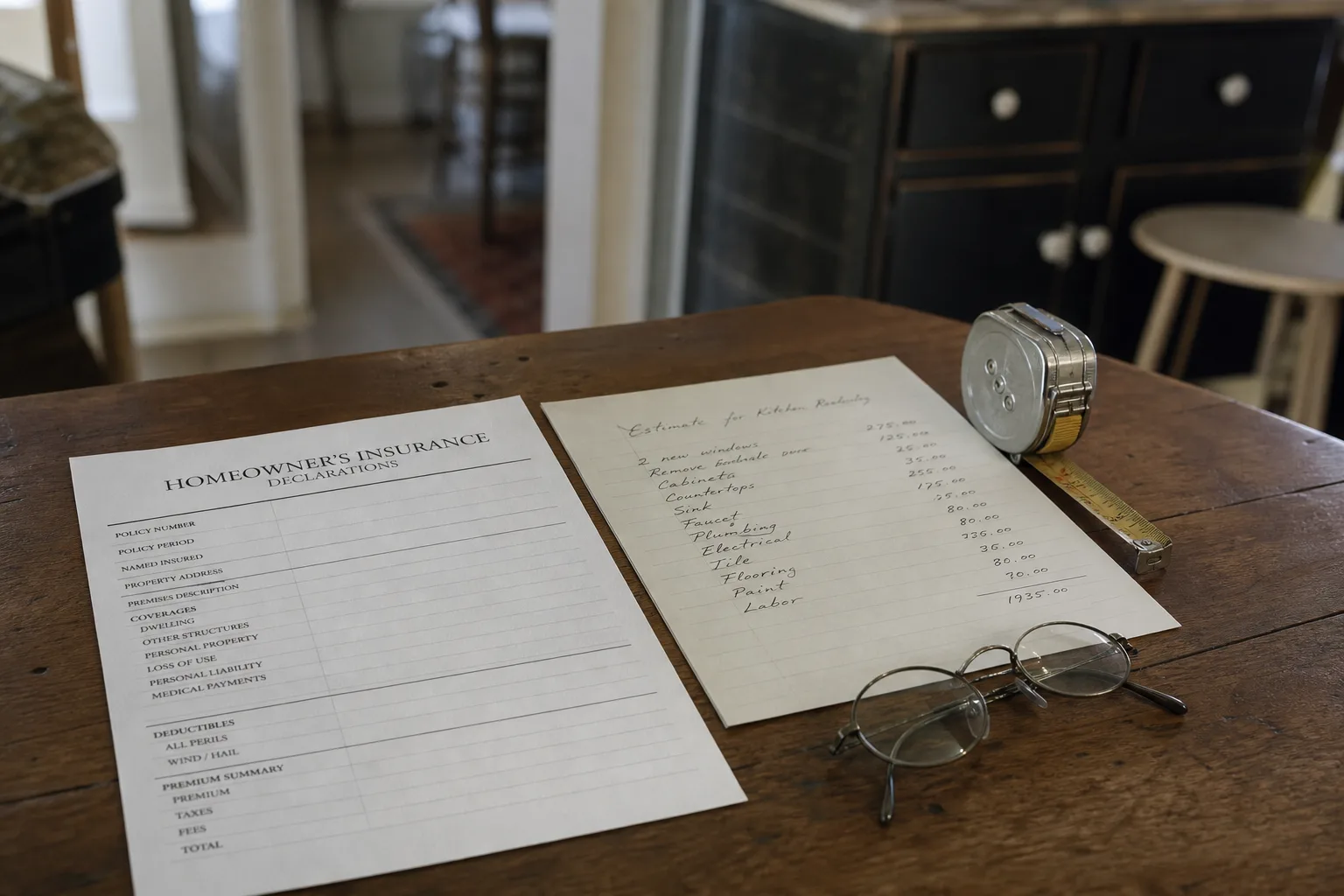
The averaging trap does not announce itself at the point of sale, and it rarely surfaces at renewal either. It surfaces on the day an adjuster hands over a scope of repair for a burst supply line in a 1911 house, and the number at the bottom is smaller than the estimate the contractor wrote, and nobody has accused anybody of anything. The policy did what it says it does. The condition that reduced the payment has been sitting in the same place for a hundred years, in the section headed conditions, and it turns on a comparison between the amount of insurance carried and the cost of rebuilding.
Why insurers started measuring the whole building against a partial loss
Fire insurance discovered early that most losses are partial. A chimney fire scorches a bedroom, a pipe lets go in a wall, a limb comes through a slate roof over the back bedroom. If a claim almost never approaches the full value of a building, an owner acting rationally will insure for a fraction of that value and still expect to be made whole on the loss he actually has. Two neighbors with identical houses would then pay very different premiums for effectively identical protection. The coinsurance clause, and the averaging clause that does the same work under a different name, corrects that by tying the payment on a partial loss to the ratio between what you carried and what you should have carried.
The usual threshold is eighty percent of replacement cost, and the arithmetic is unforgiving in its simplicity. If rebuilding your house would cost five hundred thousand dollars, the clause expects at least four hundred thousand of coverage. Carry three hundred thousand and you have satisfied three quarters of what was required, so a partial loss is settled at roughly three quarters of its cost, less the deductible, whatever the repair actually runs. Nobody disputes the damage. The reduction happens before anyone gets to the argument about scope.
Older houses drift out of compliance in ordinary weeks
Drift is the whole problem, and it happens through the same small events that make up a normal year of owning an old building. The kitchen came out in the spring and went back in with cabinets that cost what a used car costs. Someone finally reglazed and weatherstripped the original double hungs rather than replacing them, which is the right call for the house and also a line item nobody reports to an agent. The knob and tube in the back half got pulled. A porch was rebuilt in kind because the historic district required it. None of these are the sort of thing a homeowner thinks of as insurance events, and the declarations page arrives in the mail, gets glanced at for the premium, and goes in the drawer.
Meanwhile the cost of putting the building back the way it was moved independently of both the sale price and the tax assessment. Reconstruction is not new construction. It is working in a house that is standing, matching plaster profiles, sourcing lumber in dimensions the mills stopped cutting, and paying a crew that knows how to do it. Inflation guard endorsements bump the coverage a few percent at each renewal, which is better than nothing and is rarely the same number as what happened to skilled labor and materials in that period.
What to check, and the order that makes it quick
Start with the declarations page and find Coverage A, the dwelling limit, then find the conditions section and the words coinsurance, replacement cost, or the insuring agreement's percentage. That tells you the target. Next, get a reconstruction figure rather than a market figure, either from the carrier's own valuation tool run with honest inputs about your finishes and framing, or from a contractor who has worked on houses of your period and will put a square foot number in writing. Compare the two. If your dwelling limit sits below eighty percent of the rebuild figure, the fix is a phone call and a modest premium change, not a new policy.
Then ask three specific questions. Whether the policy carries extended replacement cost, which adds a cushion above the limit when a regional event drives prices up. Whether ordinance and law coverage is included and at what percentage, since bringing an old house up to current code during a repair is often the largest hidden line. And whether the carrier's valuation reflects what is actually in your walls. Owners in flood zones have a parallel version of this conversation, because the National Flood Insurance Program, administered by FEMA, is responsible for the terms on that side and applies its own limits and settlement rules.
Keeping it current without making it a project
Once the number is right, the maintenance is light. Photograph each significant job as it finishes, keep the contractor's invoice in the same folder as the policy, and send the agent a short note whenever a project changes the cost to rebuild rather than merely the look of a room. Read the renewal declarations for the dwelling limit before the premium. An old house rewards owners who keep a written record of what has been done to it, and the same record that satisfies a building department or a future buyer is the one that keeps a partial claim whole.