Your Phone Buzzes Every Time a Grade Posts. Where a Parent's Help Actually Counts
Real-time grade portals, rewritten integrity policies and retake windows have changed what useful homework support looks like, and what now counts as taking it over.
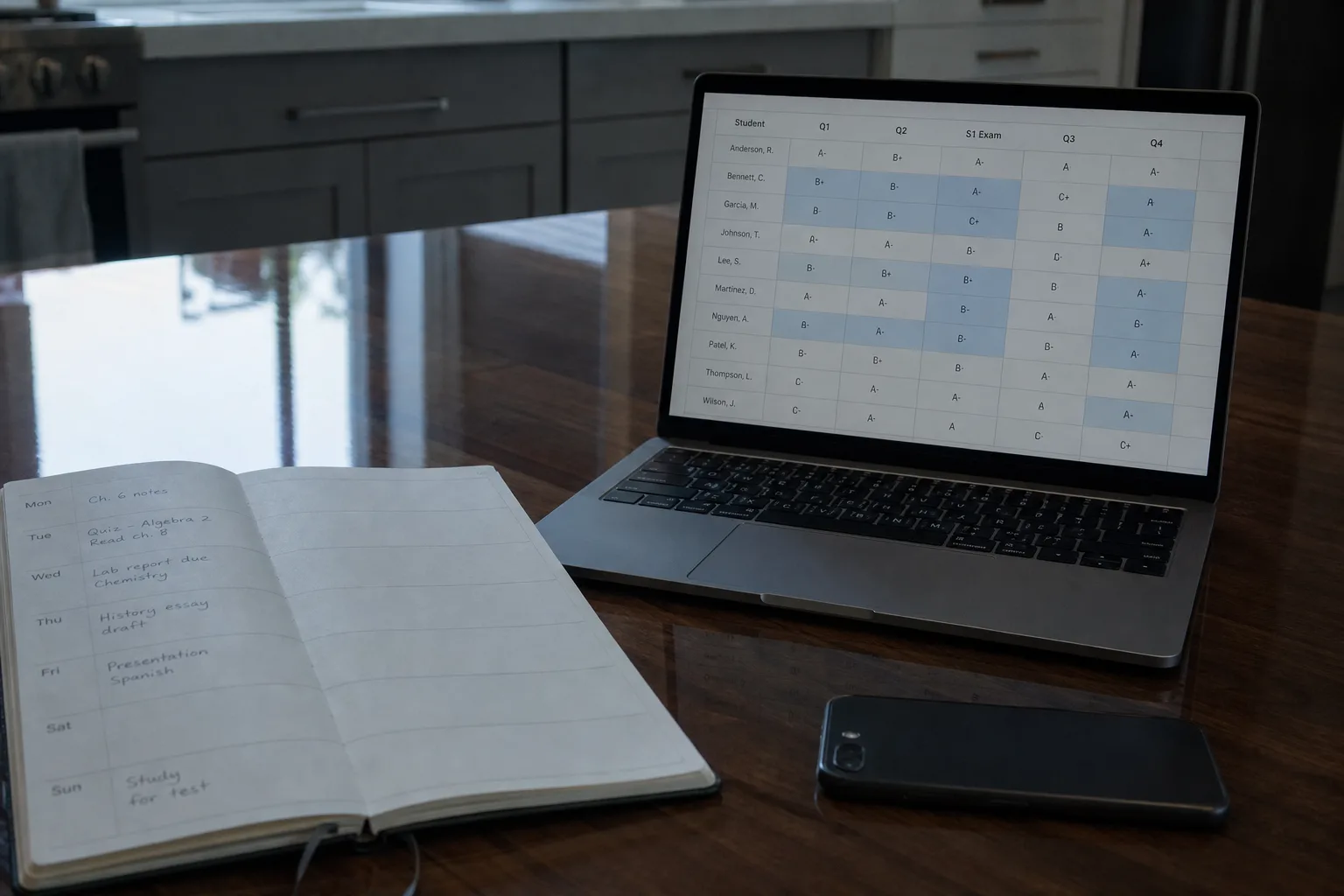
The grade portal is the largest change to household homework support in a generation, and almost nobody sat down and decided how to use it. It arrived as a default. A district adopts a learning management system, the platform offers parent accounts, notifications are switched on at setup, and within a week a parent knows about a missing worksheet before the student has walked home. What used to be a weekly or quarterly signal is now a feed. The information is genuinely better than what came before, but the volume changed faster than anyone's habits did, and the habits are what separate useful support from supervision that quietly becomes the student's own planning system.
What the portal replaced, and what it did not
Before the portals, the standard reporting cycle gave a parent a progress report partway through a term and a report card at the end, which meant intervention was retrospective and coarse. You found out about the failed unit test after the unit was over. The portal fixed the timing problem completely and created a precision problem in its place: a gradebook shows every entry at the moment a teacher saves it, including placeholder zeros for work not yet collected, ungraded drafts, and assignments weighted so lightly that a missing one moves nothing. A good job here starts with reading the weighting column before reacting to the score.
That distinction is worth an hour early in the term. Most gradebooks publish category weights, and most publish a late-work and retake policy alongside them, either in the syllabus or in the course page attached to the platform. Once you know that formative work carries a small share and summative assessments carry most of it, the feed stops being an alarm and becomes a map. The barely adequate version of parental support treats every notification as equally urgent, which trains a student to respond to whoever is loudest rather than to the deadline that actually determines the grade.
The rewritten integrity policies, and what help is now allowed to look like
Schools spent the last few years rewriting academic integrity language, because the old wording assumed the only outside help available was a person. Many districts now publish a tiered scheme: assignments where AI tools are prohibited, assignments where they are permitted for a named purpose such as brainstorming or checking mechanics, and assignments where use must be disclosed in a note at the end. Some teachers moved drafting into class time and made the in-class draft the graded artifact, which is a structural answer rather than a detection one, and it changes what a parent can usefully do at the kitchen table.
If the draft is written in class, the help worth giving at home is not editing. It is reading the prompt with the student and asking what the question is actually requiring, rehearsing an argument out loud, or quizzing on the material the draft will need to draw on. Ask to see the specific policy for the specific course rather than assuming a district-wide rule, since the tiers vary by teacher, and check whether disclosure is required for the tools a student is already using without thinking of them as AI, including grammar checkers and search summaries.
Retake windows are the intervention that pays
The second policy shift worth knowing is the spread of retake and revision windows, which many schools adopted alongside standards-based reporting. A student who bombed an assessment often has a defined period, commonly a week or two, in which a corrected attempt can replace or partially replace the original, usually conditional on completing a reteach session or a set of practice problems first. The window is short, the conditions are specific, and it closes silently. This is the single place where a parent's involvement changes an outcome more than any amount of nightly monitoring does.
Doing it well means finding the deadline and the precondition, then handing both to the student in one sentence and letting them schedule the session. Doing it badly means emailing the teacher yourself to request the retake, which produces the same grade and teaches nothing about how to ask. The line between the two is not effort. It is who makes the contact. A student who has emailed a teacher three times to arrange a reassessment has a skill that transfers directly to a college registrar, an academic advisor, and eventually a manager.
The handoff has a legal date on it
The Department of Education is responsible for federal education privacy rules, and under those rules the rights that let a parent see a student's education records transfer to the student when they turn eighteen or enroll in a postsecondary institution, whichever comes first. Colleges will generally not discuss grades, attendance, or disciplinary matters with a parent absent a signed release from the student. This is not a technicality to work around at the last minute. It is a date, and it is the reason the gradual transfer of ownership matters more than any individual assignment.
Working backward from it is the practical method. In the earlier grades, a parent may reasonably hold the calendar. By the middle grades, the student writes the deadlines and the parent checks the list once a week. By the last two years of high school, the portal notifications go to the student and the parent looks at the summary monthly, if at all, because the point of the last two years is to run the system unsupervised while the consequences are still small. A student who has never missed a deadline because someone else caught it every time has not yet been tested.
A weekly rhythm that holds up
What a good job looks like in practice is unglamorous and takes about twenty minutes. One scheduled review a week, at a set time, covering upcoming assessments, anything in a retake window, and anything that has been sitting missing for more than a few days. No mid-week reactions to individual notifications, which means turning most of them off and leaving weekly summaries on. Questions rather than corrections. The student holds the pen, the parent holds the calendar question, and the boundary between the two is stated out loud rather than assumed.
Set that up in the first two weeks of a term, when the syllabus is fresh and the weights are published, and the rest of the term mostly runs itself. The portals gave households information that no previous generation of parents had. Deciding in advance what you will do with it is what turns it into help.