Reading Your First Policy? How to Work Out What Each Exclusion Is Doing There
Exclusions are not traps hidden in the back of a homeowners policy; they are pricing decisions, and learning to sort them by purpose is a skill you can build in an afternoon.
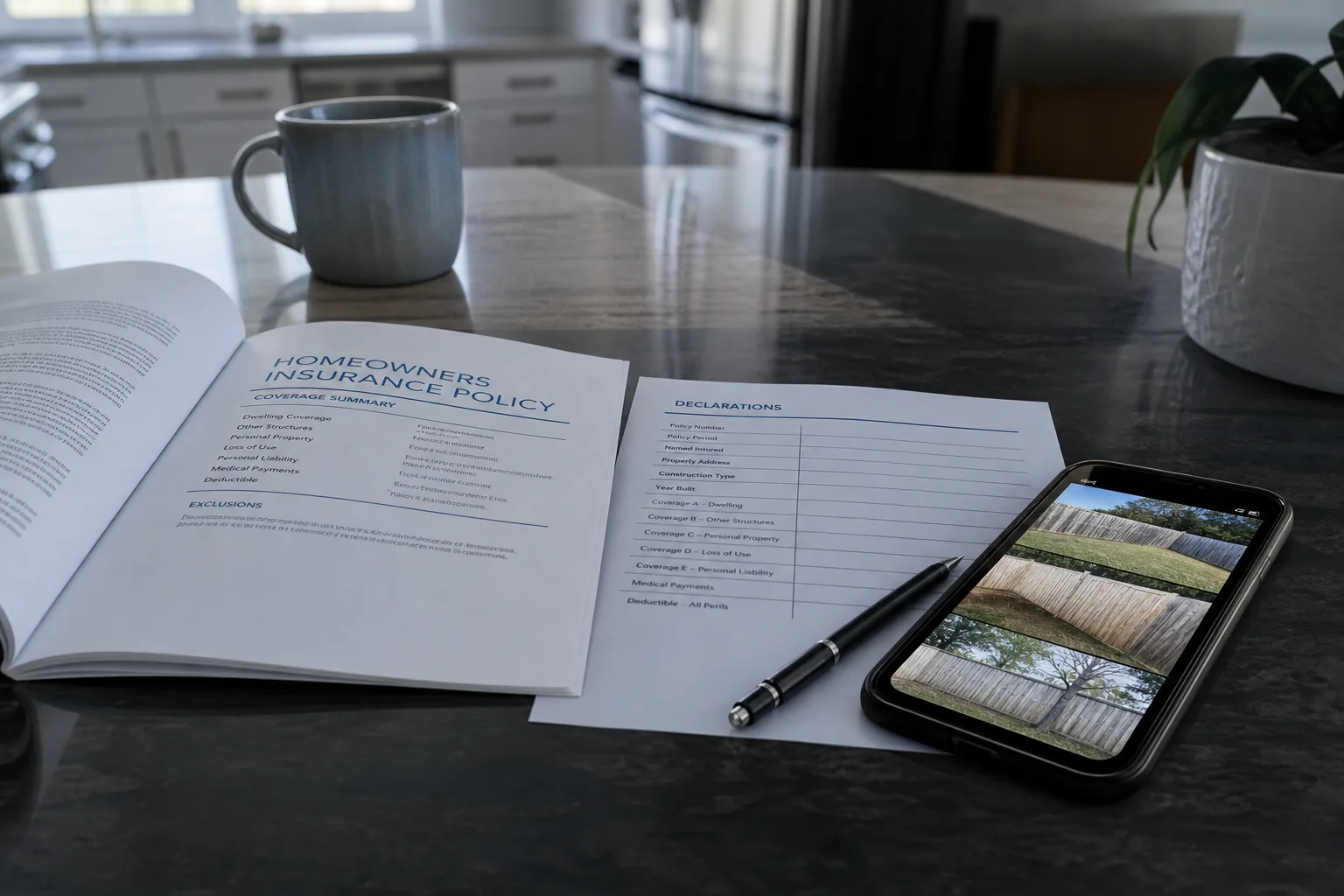
The exclusions section is where a homeowners policy stops describing what it will do and starts describing the edges of the deal, and most people meet it for the first time in the worst possible circumstances, which is to say after something has already happened. Read cold, on a quiet evening, it is a different document. The task is not to memorize it. The task is to work out, exclusion by exclusion, why somebody put that sentence in a contract that thousands of households buy, because the reason is almost always visible once you know the three or four shapes a reason can take.
Start by asking what the sentence is protecting the insurer from
An exclusion exists because a category of loss does not behave the way insurance needs a loss to behave. Insurance prices events that are sudden, accidental, and spread thinly across a large group of policyholders. When a loss is none of those things, it comes out of the policy and goes somewhere else: into a separate policy, into a rider you buy on purpose, into your own maintenance budget, or into nobody's pocket at all. Wear and tear is excluded because it happens to every roof eventually, and a contract that paid for the certain would just be a savings account with worse terms.
Once you hold that frame, the language stops reading as evasion. Earth movement, flood, ordinance or law, neglect, intentional acts by an insured: each of those is excluded for a reason you can articulate in one plain sentence. Some are excluded because they are correlated, meaning one storm ruins ten thousand houses in the same county on the same night, which is exactly the risk private capital struggles to price. Flood is the clearest example, which is why the National Flood Insurance Program, administered by the Federal Emergency Management Agency, exists as a separate line of coverage rather than a paragraph in your homeowners form.
Sort every exclusion into one of four buckets
Take the list and mark each item. The first bucket is covered elsewhere, by design: flood, earthquake in most states, auto, and anything relating to a business you run out of the house. The second is available but not automatic, meaning you can buy it back with an endorsement, which is true of water backup, service line coverage, and in many forms the ordinance-or-law expense of rebuilding to a code that did not exist when the house was framed. The third is maintenance, which is your job and always was. The fourth is genuinely uninsurable, mostly deliberate acts and criminal conduct.
That sorting exercise is the whole skill. Almost every unpleasant surprise a first-time policyholder describes turns out to be a bucket-two item that was sitting in the declarations page unbought, or a bucket-three item that a slow failure moved out of coverage over the course of two or three years. Neither is hidden. Both are decisions, and you make them at purchase and at every renewal, whether or not you notice that you are making them.
Pay particular attention to the exclusions that involve other people
The exclusions that catch neighbors off guard are the ones where the damage crosses a property line, because instinct says the person whose thing broke should pay, and policies are built on a different principle. A healthy tree that falls from next door onto your roof in a windstorm is generally your claim, on your policy, with your deductible, because your neighbor did nothing wrong and negligence is what shifts the bill. A visibly dead tree, reported in writing months earlier, is a different conversation, which is why the writing matters. Shared fences, party walls, and a contractor's access across a strip of your lawn all sit in this same territory.
Learn how your form handles water that arrives from an adjoining unit or an uphill lot, how liability coverage responds when your guest is hurt on a walkway you share, and what your policy says about damage you cause to property in your care. Then read the same paragraphs in the light of your actual neighbors: the maple leaning toward the garage, the driveway easement, the retaining wall nobody can name an owner for. Coverage becomes concrete the moment you attach it to a specific object twelve feet from your kitchen window.
Test your reading before you need it
Judgment is built by checking yourself against someone who does this daily. Write down three scenarios drawn from your own property, describe them to your agent in a single email, and ask for a written answer that cites the coverage part and the endorsement number. An email is not a coverage determination, and no honest agent will pretend otherwise, but a written answer that names a form section tells you the two of you read the policy the same way, and it gives you something to hold at renewal. Ask what an endorsement costs annually. Often the number is small enough to end the debate immediately.
Do this in the same sitting as a walk through the house with a phone camera, room by room, closets open. The photographs cost you twenty minutes and they answer the question that follows almost every claim, which is what existed and what condition it was in. Keep the declarations page, the endorsement list, and the photographs in one folder. That folder is what turns a policy from a document you own into a set of decisions you have actually made.
The second time through a policy is faster than the first by an order of magnitude, and the third time you will be reading for changes rather than for meaning. Insurers revise forms; endorsements lapse; a new fence or a finished basement moves an item from one bucket to another. Fifteen minutes at renewal, with last year's notes beside this year's declarations, keeps the whole thing current.