Your Rent Portal Changed Its Password Rules. What You Must Do, and Who Pays If the Account Is Taken
When a large property manager overhauls sign-in for its tenant portal, the new rules follow federal guidance. Here is what changes for renters, and where the loss lands.
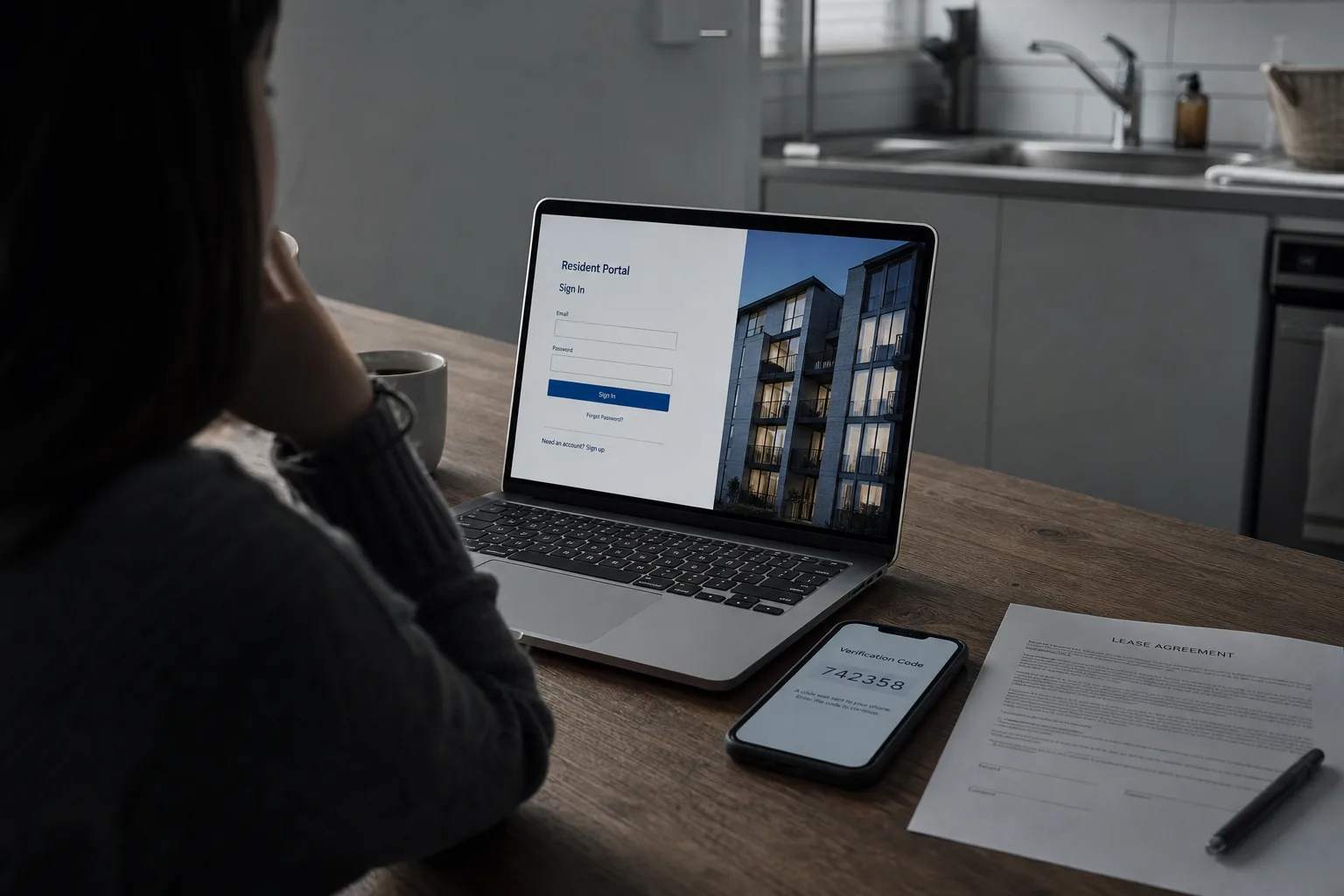
A property management company that collects rent from tens of thousands of units is, whatever it calls itself, running a payments operation. Bank routing numbers sit in those accounts, along with lease documents, prior addresses, dates of birth, and in many cases the results of a tenant screening report. That makes the sign-in page on a rent portal a more serious object than the one on a streaming service, and it explains why large providers have spent the past few years rewriting rules that had been stable since the mid-2000s. The rewrite is not cosmetic. It changes what a renter is required to do, what a renter may decline, and where a loss lands when an account is opened by somebody else.
What a provider actually changes, and the order it changes it in
The rollouts follow a recognizable sequence, and knowing the sequence tells you where you are in it. First the composition rules go: the demand for an uppercase letter, a digit, and a symbol quietly disappears from the sign-up form, and the minimum length rises. Then scheduled expiration goes, so the password that used to die every ninety days simply persists. Next comes screening, where the portal checks a proposed password against lists of credentials already exposed in other companies' breaches and refuses the ones that appear. Last, and usually with the most notice, comes a second factor at login. Providers stage it this way because each step reduces support call volume before the step that increases it.
The tenant-facing notice rarely explains any of that. It tends to say that security has been improved and that you will be asked to verify a code, which reads like an inconvenience invented by the landlord rather than a change with a documented basis. It has a basis. The National Institute of Standards and Technology is responsible for the federal government's digital identity guidance, the reference text that banks, payroll processors, insurers, and the software vendors who build rent portals read before they redesign an authentication flow. When a large provider drops forced rotation, it is not being casual. It is following the direction that guidance moved.
Why the old advice was retired, and what replaced it
The reasoning is behavioral, and it is worth understanding because it governs what you should do with your own accounts. Composition rules produced predictable output: people took a word they could remember and decorated it, so a capital went at the front and a digit and an exclamation point went at the end. Forced rotation produced the same effect over time, with a counter incrementing at the end of an otherwise unchanged password. Both rules made passwords harder for humans to hold and barely harder for software to guess. What replaced them is length, uniqueness across sites, and a check against known-compromised credentials, because the dominant attack on a rent portal is not guessing your password but reusing one you already lost somewhere else.
The practical consequence for a tenant is that the long passphrase you were previously told was insufficient is now the recommended shape, and the quarterly change you were trained to perform is now discouraged unless there is a reason to suspect exposure. A reason to suspect exposure includes a breach notice naming the portal or its vendor, a login alert from a device or city you do not recognize, or a password you know you reused on a site that has since been breached. Absent one of those, changing it on a calendar mostly increases the odds you write it somewhere insecure.
What you are required to do, and what you can decline
Second-factor enrollment on a rent portal is usually mandatory in practice even when the notice sounds optional, because the provider eventually gates the payment screen behind it. You generally do have a choice of factor, and the choice matters. A code sent by text message is the weakest of the common options, since it can be redirected by someone who persuades a carrier to move your number, and it is the one most portals default to. An authenticator app on your phone is stronger and free. A passkey, where the portal stores a credential tied to your device and your fingerprint or face unlocks it, is stronger still and is now offered by a growing share of the larger platforms. Ask which options exist rather than accepting the default.
What you can decline is narrower than renters often assume, but it is not nothing. You are not obliged to accept the portal as the only way to pay rent unless your lease says so, and many leases do not. If the lease permits a check or a bank bill payment, the portal becomes a convenience rather than a condition, and you can ask for your bank details to be removed from it. You are also entitled to ask, in writing, who operates the portal, because it is almost never the management company itself. The answer is a software vendor, and that vendor's name is the one that will appear on any future breach notice.
Where the loss lands when the account is opened by someone else
This is the part worth settling before anything goes wrong. If rent leaves your checking account through an unauthorized electronic transfer, the federal rules governing consumer electronic fund transfers apply to your bank, not to your landlord, and they set out an error resolution process with deadlines that run from the date the statement was sent to you. Reporting promptly preserves the strongest position; waiting past the outer deadlines erodes it. Your bank is therefore the first call, not the property manager. The second call is the property manager, because a reversed payment can show as unpaid rent in their ledger, and an unpaid rent flag is the thing that generates a late fee and, in a bad month, a notice to quit.
Put both calls in writing on the same day, and keep the confirmation numbers. The email to the management company should state the date, the amount, that the transfer was unauthorized, that your bank is investigating under the electronic transfer rules, and that you are requesting the late fee be held in abeyance pending the outcome. Providers with any scale have a process for exactly this, because they encounter it monthly across a portfolio, and the tenants who get a clean result are consistently the ones whose written record establishes the date they reported it.
The maintenance that actually matters now
Two small things carry most of the weight. Keep the recovery channels on the account current, meaning the email address and phone number the portal will use to verify you, because a stale recovery email is how a person loses access to their own rent history the week they need it for a new application. And make the portal password unique, stored in a manager rather than in your head, because uniqueness is the single control that turns somebody else's breach into a non-event for you.
The third thing applies to shared households. Roommates on a joint lease frequently share one portal login, which means the payment record cannot distinguish who paid, and a factor tied to one person's phone strands everyone else when that person moves out. Most large providers now support separate logins against a single lease, with split payment amounts recorded per tenant. Ask for it at signing, or ask for it now. It costs nothing and it produces a payment history with your own name attached, which is the document a future landlord will actually read.