Roof Work That Needs the Neighbor's Side Yard? Five Lines Your Scope Should Already Contain
On a narrow lot, the ladders go where they fit, which is often the other side of the property line. Five access and damage terms worth settling before the deposit clears.
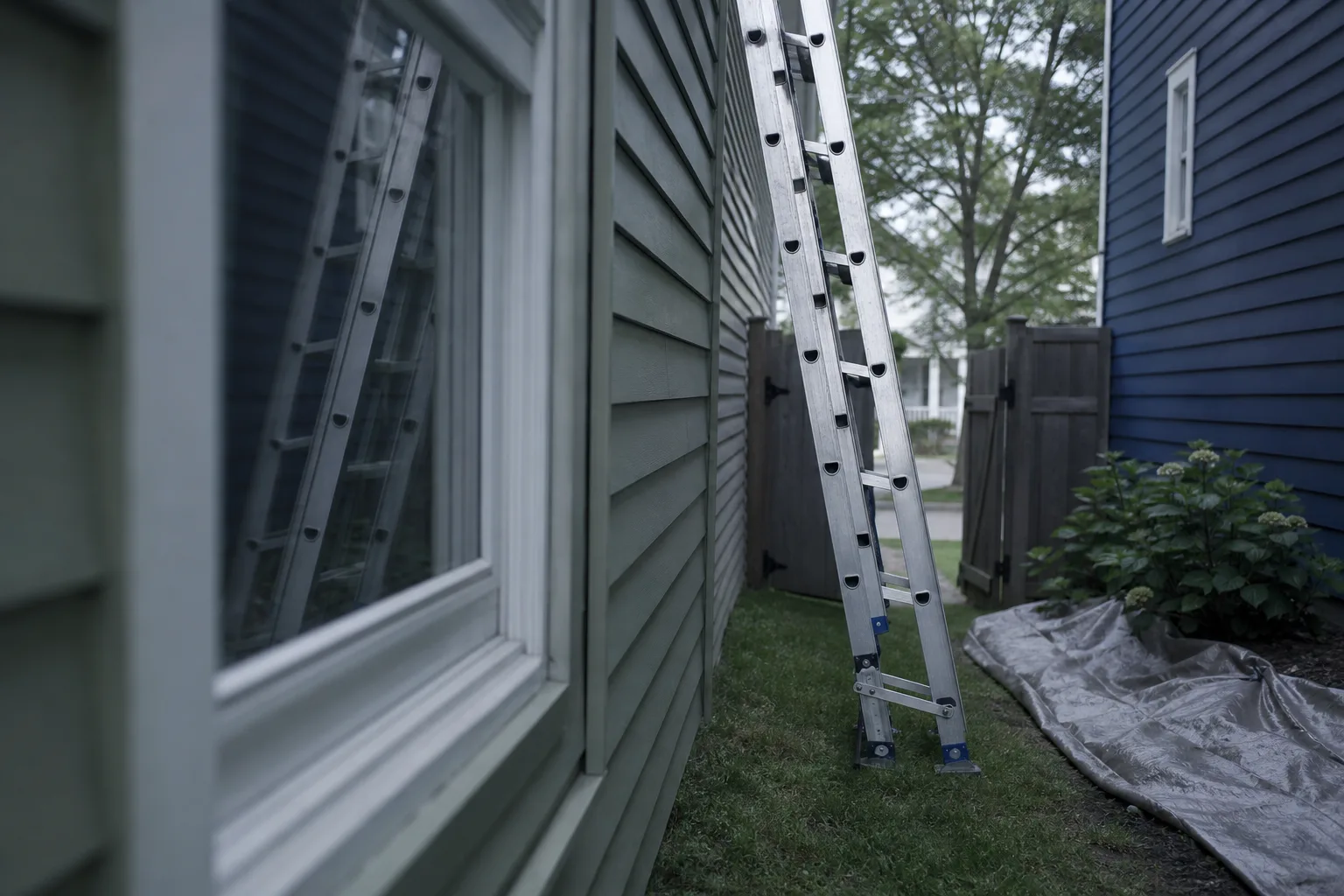
A residential roofing agreement that runs eleven pages will usually spend nine of them on the things the homeowner will eventually see: shingle weight, underlayment, ice and water shield at the eaves, ridge vent, the warranty term and the payment schedule. The part that determines whether the job ends with a neighbor who still waves is often a single line about access, and sometimes it is no line at all. On a lot where the houses sit sixteen feet apart, the ladders, the staging and the debris chute go where they physically fit, and on a great many blocks that means the strip of lawn on the other side of the property line.
1. Name the access route, and say who is responsible for obtaining permission to use it
The narrow case worth working through is the common one: a rear slope that cannot be reached from your own driveway, a side gate roughly three feet wide, and a neighbor's grass strip that is the only place a thirty-two foot extension ladder can be footed at a safe angle. Somebody has to ask. The scope should say who, and it should say it in a sentence that assigns the task rather than describing an aspiration. Contractors who work this housing stock every week generally have a form for it, because they have needed one before.
What you want in writing is the route itself, described the way a stranger would need it described: entry through the shared gate at the front, staging confined to the six feet nearest the wall, no vehicles on the neighbor's driveway apron, no material stored past the rear corner of the house. A route that exists only in the foreman's head changes when the foreman is out sick. A route written into the scope is what the second crew reads on the morning the first crew is finishing another job across town.
If the permission has not been obtained when you sign, the scope should say what happens if it is refused. Usually the answer is a different and slower method, roof jacks and a longer ladder set from your own side, at a stated additional cost. Knowing that number before the deposit clears is the difference between a conversation with your neighbor and a negotiation with your neighbor.
2. Put the start time in the document rather than leaving it to the crew's habits
Most municipalities set an hour before which construction noise is a code violation, commonly somewhere in the seven o'clock range on weekdays and later on Saturdays, with Sunday work restricted or prohibited outright. Your city clerk or code enforcement office can tell you the exact window in an afternoon phone call. That published hour is the floor, not the plan. A crew that pulls up at six fifty to unload and stage is technically compliant and practically a problem, because the noise that annoys the neighbor is the tailgate and the compressor, not the nail gun.
Write the arrival hour into the scope, and write the hour when compressors shut off. Tear-off on a full roof is the loudest day of the job and it is also the shortest, so a scope that identifies which day that is gives everyone within earshot something to plan around. Neighbors who work night shifts, who have an infant, or who take calls from home will nearly always accommodate one known loud day. What they cannot accommodate is nine days of not knowing.
3. Photograph the neighbor's side of the line before anything leans on it
A condition survey sounds formal for a two-day roof, and it takes about twenty minutes. Before the first ladder goes up, someone walks the access route with a phone and photographs what is already there: the hairline crack in the neighbor's walkway, the flattened hosta bed, the gutter that was already pulling away, the paint scuffed on the fence rail. Date-stamped images, stored somewhere other than one person's camera roll. The scope should state that this happens and who does it.
The value is not that it proves the crew innocent. The value is that it makes the conversation about repair short and specific instead of long and adversarial. When the neighbor points at a cracked paver in week three, a photograph either settles the question or ends the argument in the neighbor's favor immediately, which is also a good outcome, because the paver costs less than the standoff. Ask, too, that the scope commit to a restoration standard: grass reseeded, beds re-mulched, the gate hardware reset if it was taken off its hinges to get material through.
4. Say where the dumpster sits and what happens to the debris that misses it
Dumpster placement is the single most common source of neighbor friction on a residential re-roof, because a twenty-yard container is longer than most driveway aprons and heavier than most driveways were built for. The scope should name the location, the size and the protection under it, which on asphalt usually means plywood sheets. If it goes in the street, ask which party pulls the right-of-way permit and who pays the fee, because street placement can also mean the loss of two parking spaces on a block where parking is the standing grievance.
Tear-off produces nails. They land in grass, in flower beds, in the gap between the houses, and they end up in tires and in dogs' feet. A scope worth signing says the crew magnet-sweeps the perimeter, including the neighbor's side of the line, at the end of each day rather than at the end of the job. Tarping the adjoining property during tear-off belongs in the same sentence. These are ordinary practices for experienced crews, and putting them on paper simply confirms which kind of crew you hired.
5. Read the insurance certificate for what it says about adjoining property
Every contractor will hand you a certificate of insurance. The useful question is not whether general liability exists but what it covers when the damage is to property that is neither yours nor theirs. Ask for the certificate directly from the agent or carrier rather than as a forwarded image, confirm the policy period covers your scheduled dates, and confirm that workers' compensation is in force for everyone who will be on the roof. The Occupational Safety and Health Administration is responsible for fall protection standards on residential construction, and a contractor who can speak fluently about ladder setup and anchor points is generally the same contractor whose paperwork is current.
Where the access route crosses the line, some homeowners ask that the neighbor be added as an additional insured for the duration, or at minimum that the neighbor receive a copy of the certificate. Carriers handle this routinely. It costs little and it changes the character of the request you are making, from a favor to a documented arrangement with a named party standing behind it. Neighbors who have been handed a certificate rarely ask a second question about the ladders.
The practical move is to send your neighbor the relevant paragraphs a week before the trucks arrive: the access route, the hours, the dumpster location, the dates, and a phone number for the project manager that is not your own. Most people say yes to a plan and hesitate at a surprise. A scope that already answers those five questions gives you something to send, which is why the roofers who work these blocks tend to write it that way in the first place.