Shared Tree, Shared Wall, One Specialist. How to Tell Good From Plausible on Paper
When a boundary or noise problem needs an outside specialist, the difference between competence and confidence shows up in four documents, not in the first phone call.
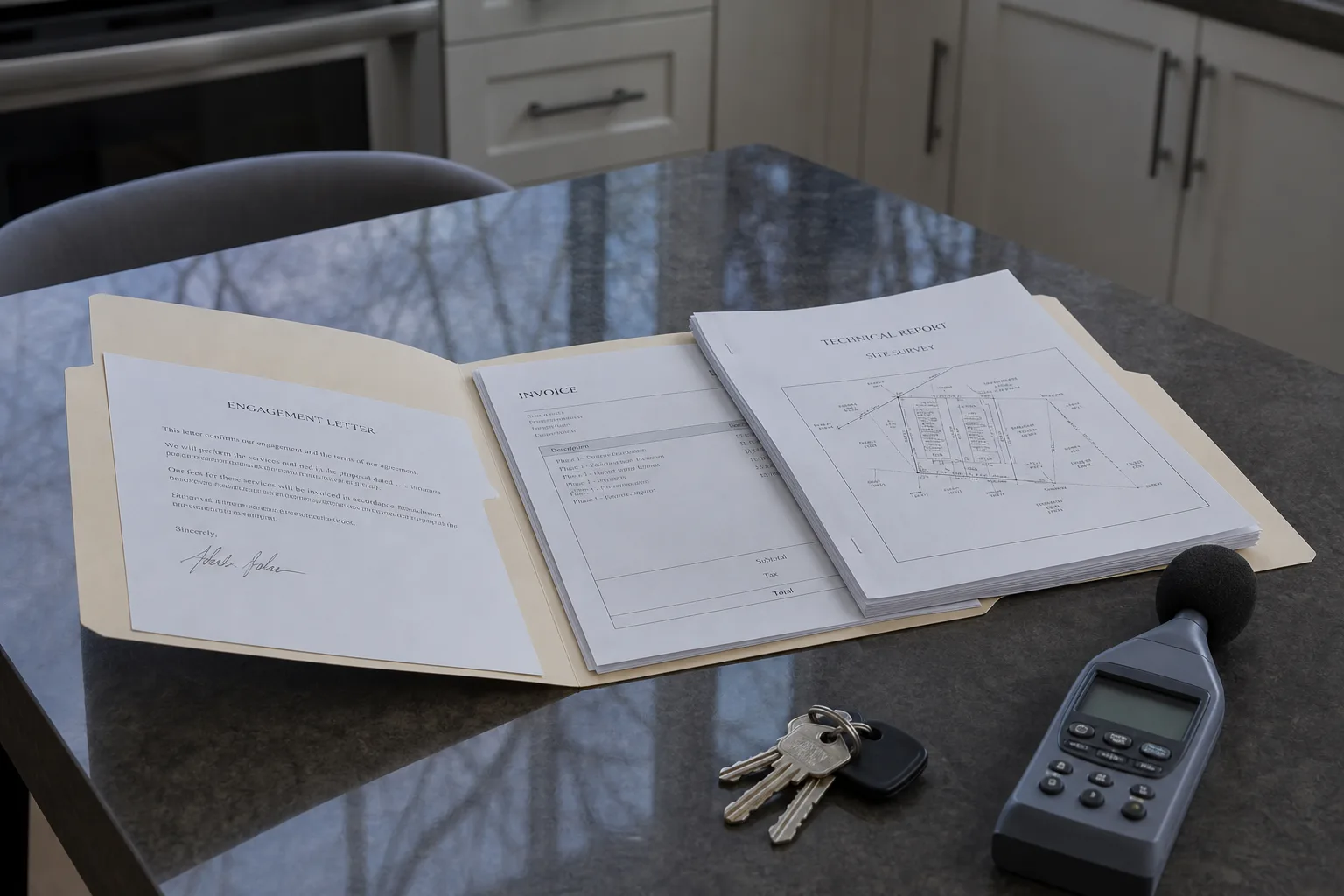
The moment a neighbor problem outgrows a conversation, somebody suggests hiring an expert. An arborist for the maple whose roots are lifting a shared driveway, an acoustic consultant for the rental unit upstairs, a land surveyor for the fence line that nobody has looked at since the deed was drawn. The suggestion is usually right. What follows is harder, because the market for that expertise contains people who are genuinely good and people who are merely plausible, and both answer the phone warmly, both use the vocabulary, and both quote a number that sounds reasonable. The separation happens on paper, and it happens early.
You are buying a document, not an afternoon of someone's attention
The single most useful reframe is to stop thinking about hiring a person and start thinking about commissioning a deliverable. Ask what physical output you will hold at the end: a stamped plat, a written report with the instrument make and model recorded, a letter of opinion on your letterhead or theirs, a set of photographs keyed to measurements. A good specialist answers that question in one sentence and often volunteers a redacted sample from a previous job. A plausible one answers by describing the process, the site visit, the assessment, the discussion afterward, and never quite arrives at the noun. That gap is diagnostic and it costs you nothing to test.
The reason this matters is that the deliverable is what travels. Your recollection of what the arborist said in the yard is worth very little to an insurance adjuster, a code officer, a mediator, or your neighbor's attorney. A dated report with a named author, a described method, and a clear conclusion is worth something to all four. So the question you put in the first email is not whether they can look at the problem. It is what you will receive, in what format, by what date, and whether it is written to be read by somebody who was not there.
Reading the engagement letter for what it leaves out
Most competent professional services firms send an engagement letter or a written proposal before any work starts. Read it twice, once for what it says and once for what it quietly declines to say. Three omissions recur. The first is the scope boundary: does the fee cover only the initial assessment, or the follow-up questions that always arrive after your neighbor reads the report. The second is the revision policy, meaning whether a factual correction costs you anything. The third is use, which is the clause governing whether you may hand the report to a third party or publish it in a hearing packet.
That third one catches people. Some reports are issued for the client's internal information only, with language restricting reliance by anyone else, and a document you cannot show to the zoning board is a document you paid for twice. If the letter is silent, ask for an added sentence permitting disclosure to named parties: your insurer, your town, your attorney, the other household. A specialist who works in disputes will agree without friction because they write for that audience anyway. One who hesitates is telling you something useful about the kind of work they normally do.
Fee structure deserves the same plain reading. Hourly is not worse than fixed, and fixed is not automatically safer, but the two failure modes differ. Hourly without a not-to-exceed figure invites drift; fixed without a defined scope invites a change order the first time the job proves more complicated than the driveway suggested. The version that tends to work for a bounded neighbor question is a fixed fee for the assessment and the written report, plus a stated hourly rate for anything afterward, with the trigger for that hourly clock written down rather than assumed.
What the ordinary week between milestones should look like
Engagements rarely fail at the proposal or the final report. They fail in the flat middle weeks, when the site visit has happened, the report has not arrived, and nobody has said anything. A well-run engagement produces small, boring artifacts during that stretch: a note confirming the visit date and who needs to be home, a one-line message saying the field data is in and the draft is due Thursday, a question about the deed language rather than a guess at it. None of that is impressive. All of it is evidence that someone is tracking your job against a calendar rather than against memory.
You can generate that rhythm yourself with very little effort. After every phone call, send a four-sentence email summarizing what was agreed and what happens next, and ask them to correct anything wrong. Keep one folder, physical or digital, with the proposal, the invoices, the correspondence and the drafts in date order. Log the date and substance of each contact in a single running document. This is not defensive record-keeping against a professional you expect to disappoint you. It is the material you will need if the matter ever moves to a claim, a permit, or a mediated agreement, and assembling it later from an inbox is miserable.
Two weeks of silence is worth one polite email, not an escalation. The useful version asks for a date rather than an apology: when should you expect the draft, and is there anything outstanding on your side. Most delays turn out to be an unreturned question about access, a document the county was slow to produce, or a scheduling conflict that a single message resolves. Specialists who handle neighbor matters are used to clients who ask; the ones worth keeping treat the question as normal housekeeping.
Credentials that do work, and credentials that just hang there
Licensure is the sharpest filter available, and it is not the same thing as certification. A land surveyor practicing in your state holds a state license with a number you can verify through the state board in a few minutes. Many acoustic and environmental consultants are licensed engineers; others hold board certifications from professional societies, which can be meaningful but are issued by the society, not the state. Arborist credentials are largely certification rather than licensure, though tree work itself often requires a contractor license and insurance. Verify the license number yourself rather than accepting the logo on the letterhead.
Instruments deserve one question too. If the deliverable depends on a measurement, sound pressure levels at a shared wall, moisture readings, elevations across a driveway, ask what equipment is used and whether it is calibrated on a documented schedule. The National Institute of Standards and Technology is responsible for the measurement standards that sit underneath that calibration chain, and a specialist whose report names the instrument and the calibration date is producing something a third party can check. A number with no instrument behind it is a claim. A number with a calibrated instrument, a date and a signature is a finding, and findings are what settle boundary and noise questions without anyone filing anything.
The whole test fits in a first email: what will I receive, when, who may I show it to, and what does the follow-up cost. Four questions, answered in writing before money moves, sort the field faster than any amount of reputation-checking. The people who are good at this work answer them briskly, because they have written those answers a hundred times and the clarity saves them trouble too.