Sharing a Wall With the Leak? The Readings That Decide When the Fans Leave
A drying job in a shared wall is settled by moisture readings and a daily log, not by how dry the drywall feels on day three.
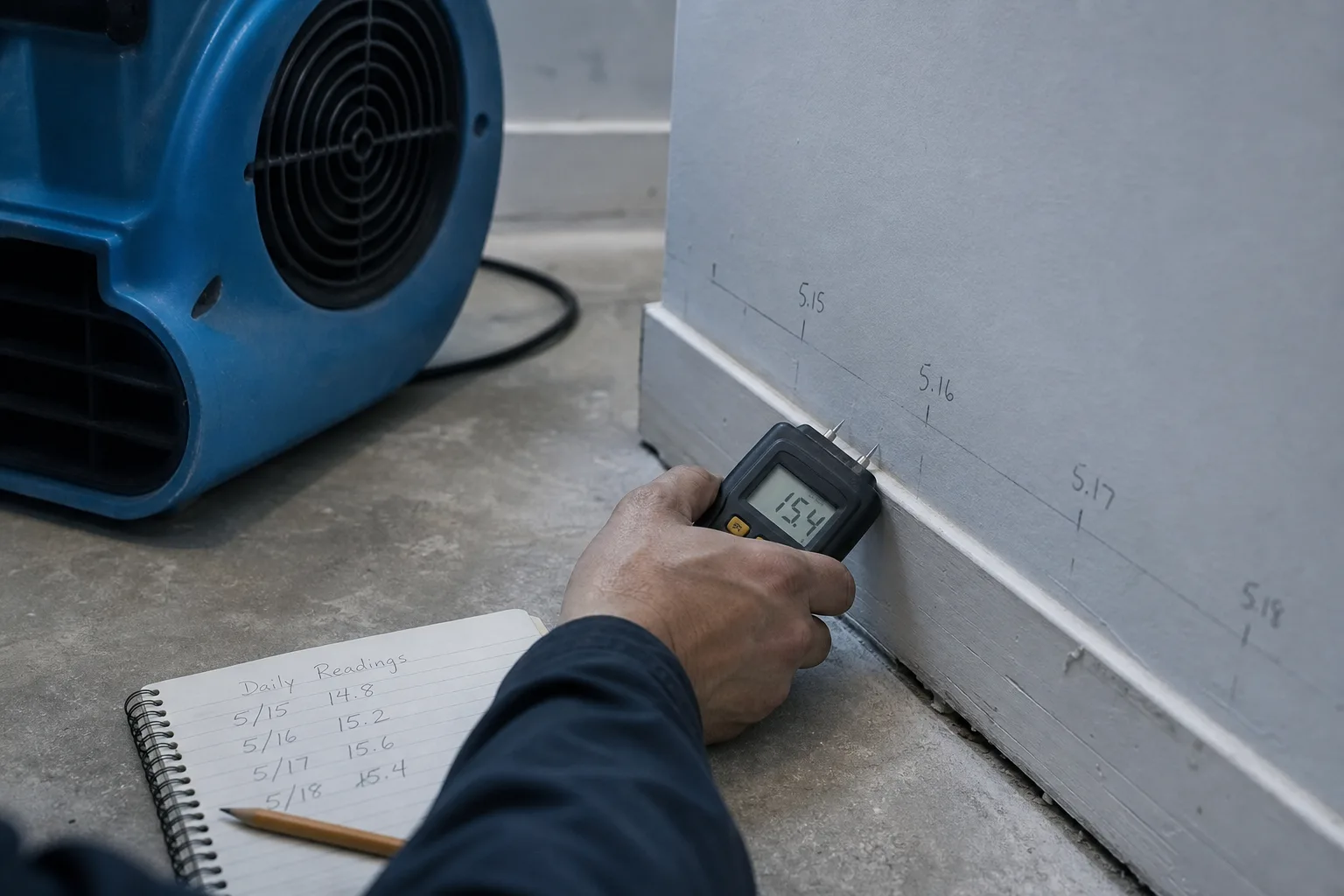
The argument I have watched most often between neighbors after a water loss is not about who caused it. It is about when the equipment comes out. One household wants the noise gone by the weekend; the other has a wall cavity that is still holding water and a restoration crew that will not sign anything saying otherwise. Both people are being reasonable. What settles it is not persuasion, and certainly not the way the drywall feels when you press a palm against it, but a short stack of readings taken in the same places on consecutive days.
The log is the whole argument, and it belongs to both units
A competent drying job produces a daily record: outside temperature and humidity, the same figures inside the affected rooms, the grain moisture content or scale reading at fixed measurement points, and a note of what equipment was running and where. The points get marked, sometimes in pencil on the baseboard, so tomorrow's reading is taken in the same square inch as yesterday's. That is the entire case for keeping fans another two days, and it is also the entire case for pulling them. Ask for a copy each evening, not at the end. When a wall is shared, ask the crew to log both sides.
The reason to ask on day one is that a log assembled after the fact is worth very little to an adjuster and nothing at all to a neighbor who has decided you are being dramatic. A record that shows a reading dropping, plateauing, then dropping again after a fan was repositioned is a persuasive document, because it describes a process rather than a conclusion. It also protects you in the other direction. If the numbers are flat for three days with equipment running, something is wrong with the setup, and you want that visible while it is still fixable.
Drying quickly is a real goal; drying fast is a different thing
I want to be careful about what I am arguing against, because speed is not the enemy. Getting air movers and dehumidifiers in within hours genuinely reduces the amount of material that has to come out, and every experienced crew treats the first day as the one that decides the size of the job. What I object to is ending the job early, which is a separate decision made several days later, usually because the surfaces look fine and the noise has become intolerable. Surfaces dry first. The framing, the bottom plate, the cavity behind a shared wall, and anything under a tile bed dry considerably later.
The consequence of stopping at the surface is rarely dramatic. It is a faint smell in August, a section of baseboard that cups the following spring, or a paint blister on the neighbor's side that arrives long after everyone has stopped connecting events. By then the claim is closed, the crew has moved on, and the conversation you have to open is one where nobody can prove anything. The Environmental Protection Agency is the federal body responsible for guidance on indoor moisture and mold, and the theme running through that work is straightforward: material that stays wet becomes a different and more expensive problem.
The paperwork that keeps a shared wall from becoming a dispute
Where a wall, floor assembly or plumbing chase is shared, the drying plan stops being your private business. You need three short documents, and none of them requires an attorney. First, a written access note to the adjoining unit: what needs to be checked, on which days, in which rooms, and who will be present. Second, a photograph set of the neighbor's side before anything is moved, so nobody inherits a scuff that predates the leak. Third, an equipment note listing what is running on their side, when it was placed, and when it is scheduled to be removed.
That third document is the one people skip and the one that does the most work. It converts an open-ended imposition into a defined one, and an imposition with an end date is something most neighbors will absorb without complaint. If the end date moves because the readings have not come down, you send the log entry that shows why. In a condominium or co-op, send copies to the manager the same day, because the association's own records will eventually be the place anyone looks to establish who did what and when.
Electricity, noise, and the small courtesies that cost nothing
Dehumidifiers and air movers on a neighbor's circuit for a week draw real power, and the amount is small enough that nobody wants to fight about it and large enough that nobody wants to eat it silently. Offer to cover it before you are asked, in writing, and settle it against a copy of their bill or a flat figure you both accept. Ask the crew where the equipment can be placed to reduce noise in a bedroom, because there is usually some latitude. Confirm the running hours. Tell them, honestly, that the fans are loud and that you are sorry about it.
None of this is generosity. It is the cheapest available insurance against a neighbor who quietly unplugs a dehumidifier at eleven at night and does not mention it, which happens more often than crews admit and shows up in the log as a single unexplained flat day. A neighbor who has been told the plan, given an end date, and offered the electricity is a neighbor who calls you when the machine trips a breaker instead of leaving it off.
What a finished job looks like on paper
Insist on a closing document rather than a phone call. It should state the final readings at each marked point, the comparable dry standard used, the date equipment was removed, and the name of the person who signed off. Keep it with the claim file, the photographs, the access notes and the daily logs, and keep a duplicate set for the adjoining unit. If a question surfaces two years from now, that folder answers it in about four minutes.
The reading that matters is the one taken inside the wall on the day the fans leave. Everything else is an opinion, including yours and mine.