Think a Breach Notice Means You Were Hacked? What It Reports, and What to Do
A breach letter reports what a company determined about its own records, not what happened to your accounts, and the difference changes what a household should do first.
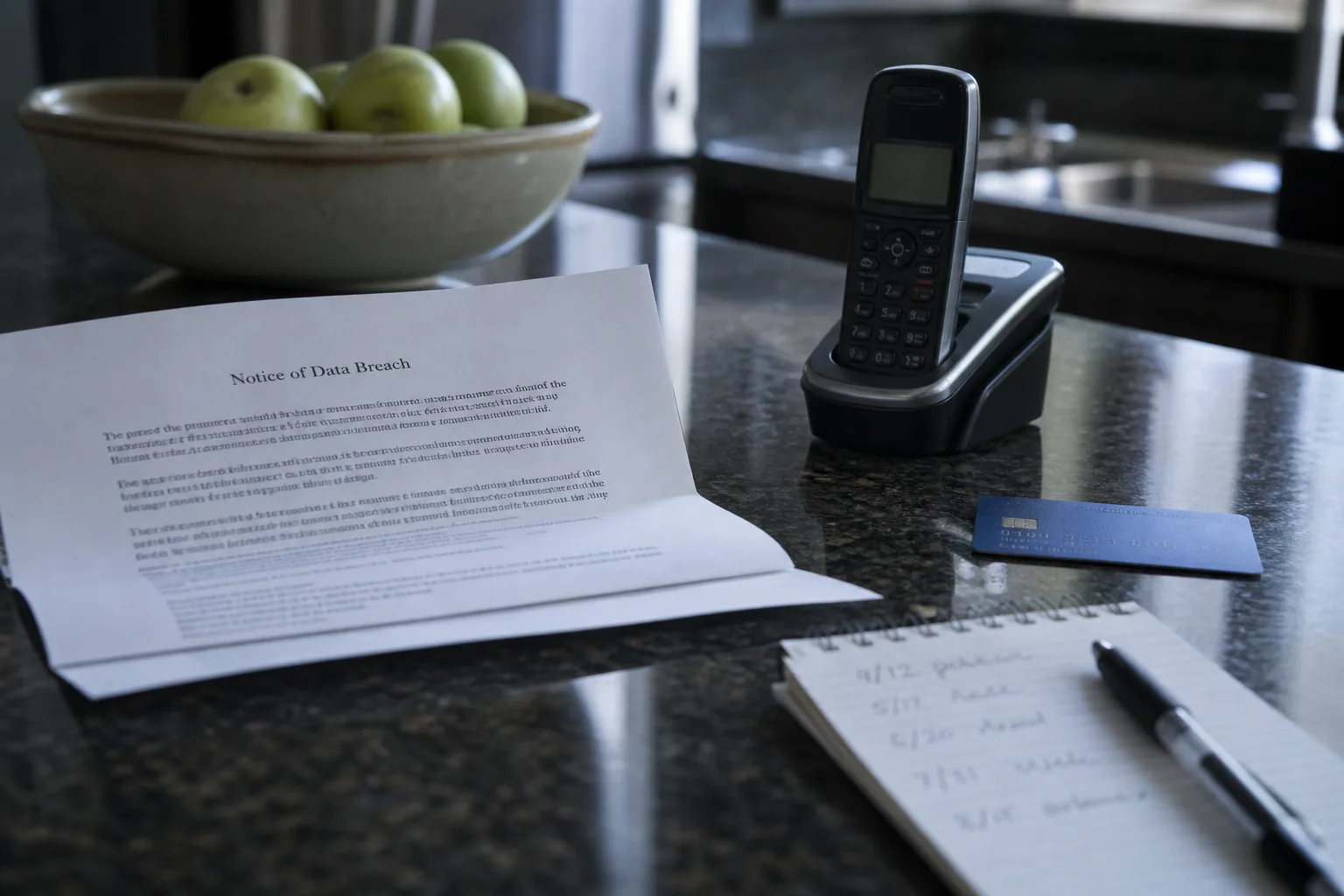
The envelope usually looks like a billing insert, arrives from a company you half remember, and opens with a sentence about the firm's commitment to protecting information. The near universal reading, in most kitchens, is that someone has broken into your account and that the damage is already underway. That reading is wrong in a specific and useful way. A breach notice is a statement about a company's own records, made after that company finished an internal determination, and it says almost nothing about whether any individual has suffered a loss. Understanding what the document is reporting changes the order of everything you do next.
The letter reports a records finding, not an event in your life
When a company writes to you, it is telling you that a set of files it held was accessed, copied, or exposed, and that your name appeared somewhere in that set. The determination is about the files. It is not a forensic finding that your specific record was read, sold, or used, and in most cases the company genuinely cannot tell you which of those happened. Notification laws in most states are triggered by exposure of defined categories of personal information, not by proof of harm, which is why letters go out to people whose lives are never touched.
That distinction matters because it tells you what the letter can and cannot answer. It can tell you which data classes were involved, because the company had to inventory them to decide whether it owed you a notice at all. It cannot tell you whether a criminal opened anything in your name, and the absence of that answer is not evasion. The practical consequence is that your first move is not damage control at the breached company. It is checking the places where your own exposure actually lives, which is usually somewhere else entirely.
The gap between the incident and the mailbox is normal, and it reorders your work
Most notices arrive weeks or months after the incident date, and the letter often prints both dates plainly. Households read that gap as negligence. Sometimes it is. More often it reflects the sequence a company has to run: detect, contain, bring in outside investigators, reconstruct which records were in scope, match those records to current addresses, and then clear the language with counsel and, where required, with a state attorney general. Several states also give law enforcement authority to delay a notice while an investigation proceeds, which can stretch the timeline further.
What the gap changes is where you look. If the data left months ago, any immediate misuse has already had its window, so a check of recent statements answers more than a change of password does. Pull the last several months of activity on the accounts most likely to be touched, not just the current cycle. Look for small test charges, address changes you did not make, and password reset emails you ignored at the time. The letter is late news about an old event, and old events leave traces you can go back and read.
Sort the exposure by what can be reissued and what cannot
Every breach letter contains a sentence listing the categories involved, and that sentence is the only part worth reading closely. Separate what was exposed into two piles. In one pile go the things a bank or a merchant can cancel and replace: card numbers, account numbers, login credentials, security question answers. In the other go the things that follow you permanently: Social Security number, date of birth, driver's license number, medical record identifiers, and the combination of full name and current address. The first pile calls for a phone call. The second calls for a standing arrangement.
For the replaceable pile, the work is finite and ends. Call the issuer, ask for a new number rather than a monitoring flag, and change the password anywhere that credential was reused, which is the step most households skip and the one that actually closes the exposure. For the permanent pile, a freeze at each of the three nationwide credit bureaus is the measure that stops a new account from being opened, and it is free to place and free to lift. The Federal Trade Commission oversees identity theft reporting and recovery guidance for consumers, and it is the right starting point when you are deciding which measures fit which exposure.
The credit monitoring offered in the letter is worth enrolling in if you have the twenty minutes, because it costs nothing and it watches. It is worth being clear about what it does, though. Monitoring tells you after something has appeared. A freeze prevents the appearance in the first place. If you do only one of the two, do the freeze, and treat the enrollment code as a secondary convenience rather than the remedy the letter implies it is.
Work it as a household, because the exposure rarely stops at one person
A letter addressed to one adult usually describes records that involved more. Joint accounts, a spouse listed as an authorized user, a child covered on a health plan, a parent whose bills you pay: all of them may sit inside the same exposed file without receiving their own envelope. Sit down once with everyone whose information could plausibly have been in that record set and decide together, in one conversation, who freezes what. Splitting this by assumption is how one person freezes three bureaus and another freezes none.
Children deserve particular attention, because a minor's Social Security number is attractive precisely for the reason it seems harmless: nobody checks it for a decade. A parent or guardian can place a freeze on a minor's credit file, and once it is in place it sits there quietly until the child needs it lifted. An elderly parent whose mail you sort is the other case worth handling deliberately, since the notice may arrive at an address they no longer monitor closely and the response window passes without anyone reading it.
There is also the letter addressed to someone who used to live at your address. You are not obliged to chase them down, but a forwarded envelope or a short message is the sort of small courtesy that costs a stamp and spares a stranger a bad year. Mark it and send it back to the carrier if you have no way to reach them. That is the whole obligation, and it is a light one.
Write down what you did, then let it end
Keep the letter. Note the date it arrived, the incident date it cites, the categories listed, and what you did in response, with the dates of each call and each freeze. A single page in a folder or one note file is enough. If a fraudulent account ever does appear, that record is what converts a dispute from your word against a collection agency into a documented sequence, and it is far easier to write down now than to reconstruct from memory two years out.
Then set a boundary on the work. A freeze that is in place does not need checking weekly, and a monitoring service that has your email address will tell you when it has something. Most households that get a breach letter will never see a consequence from it, and the appropriate response is a contained afternoon of specific steps rather than a permanent low hum of worry. Put a reminder in the calendar to review your credit reports in six months, and close the folder.
What makes these letters manageable is that the useful actions are short, cheap, and mostly permanent once taken. The freeze stays until you lift it. The reissued card arrives in a week. The reused password, once changed everywhere it appeared, stops being a thread anyone can pull.