Two Work Orders, One Slow Drain. The Technician's Note Decides Who Pays Later
In a rental, the difference between a good upkeep job and a barely adequate one is usually written down by the technician, and it surfaces at move-out.
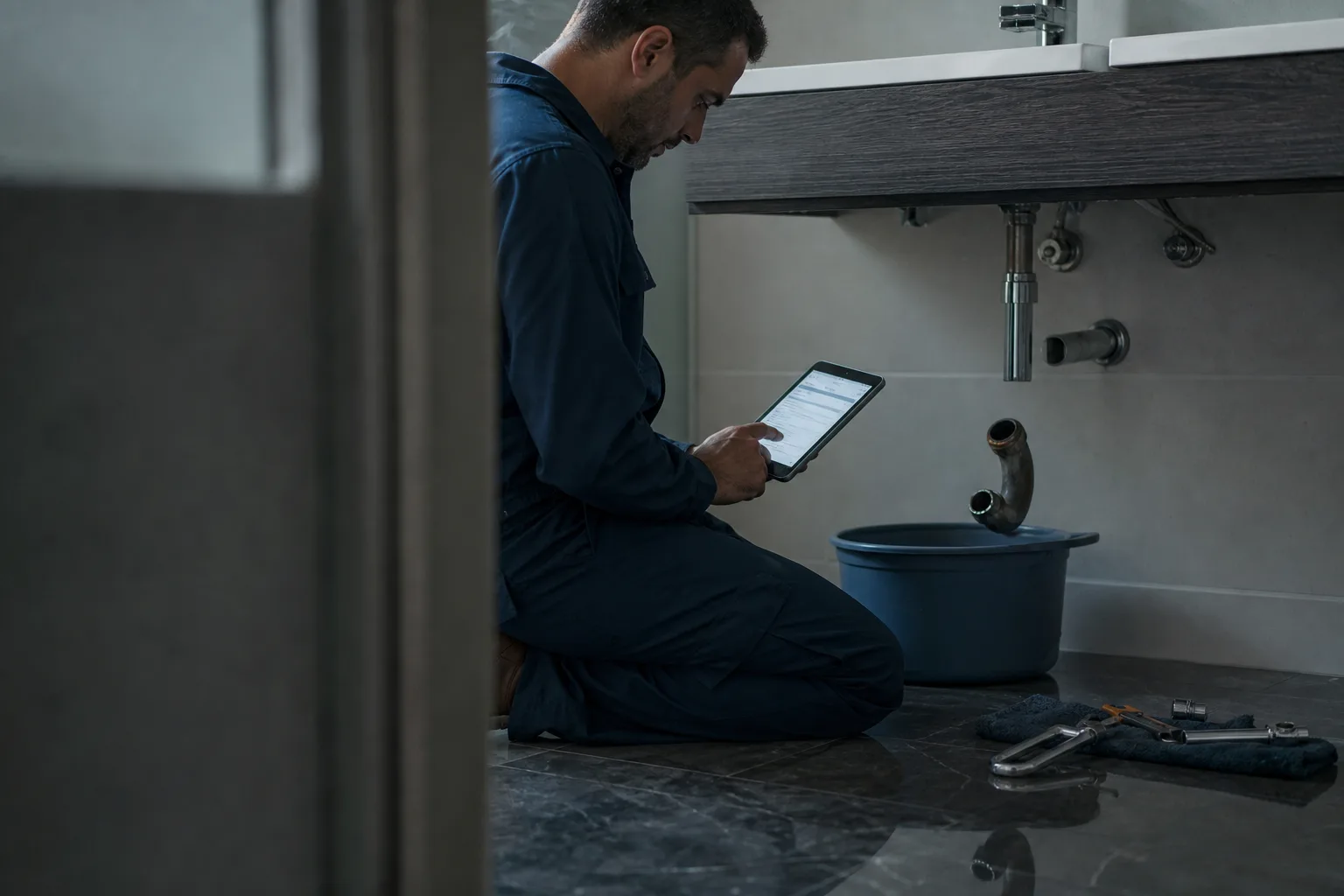
In a rental, small neglect rarely gets settled at the moment it is noticed. It gets settled months later, in a line on a move-out statement, and the document that decides the argument is usually one nobody in the transaction thought of as a document at all: the note a maintenance technician typed into a work order after a fifteen minute visit. Tenants think of the visit as the fix. Property managers think of the note as the record. Those two beliefs produce very different outcomes when a slow drain turns into a stained cabinet floor, and the gap between a good job and a barely adequate one lives almost entirely inside that note.
The party nobody counts as a party
The lease has two signatures on it, so most people reason about upkeep as a two-sided deal: you report, the landlord repairs. In practice a third party does the work and writes the history. It might be an in-house tech, a plumbing vendor on a service agreement, or a turnover contractor who sees the unit once. That person chooses what to call the problem, whether to name a cause, and whether to record that the same fixture was visited before. None of those choices are yours, but all of them are available to you if you ask while the technician is standing there, and a courteous question at the door is far cheaper than a dispute at the end of the term.
Same slow drain, two versions of the visit
A barely adequate job on a slow lavatory drain is a plunger, a hand auger, water running clear, and a note that reads something close to cleared blockage. A good job pulls the trap, looks at what comes out, and says so: hair and soap, or grease, or a section of corroded pipe shedding scale, or roots in the building line. The physical work can be nearly identical. The record is not. Cleared blockage puts the cause nowhere, which means it can later be placed on tenant use. A note naming a failing trap arm places it on the fixture, where it belongs, and no deduction survives contact with that sentence.
The same split shows up in every recurring item in a unit. A bathroom exhaust fan that hums without pulling a tissue against the grille can be wiped and left running, or it can be opened, cleared at the housing, checked for a duct that has come loose in the joist bay, and written up as insufficient airflow at the register. The Environmental Protection Agency is the federal body responsible for indoor air quality guidance, and moisture removal is the entire job of that fan. When it is documented as underperforming, the mold that appears on the ceiling six months later has a paper cause that predates it.
What a good job leaves behind besides a working fixture
Three things separate the two standards, and none of them cost the vendor much time. First, a cause, stated plainly, rather than an action verb standing in for a diagnosis. Second, a scope boundary: what was addressed, what was observed and deferred, and what needs a different trade. Third, a next date, whether that is a return visit, a part on order, or a recommendation that the item be checked at a stated interval. Read those three together and you have something that functions like a service history on a car, which is exactly what a hard-fought security deposit dispute turns on.
You can usually get all three without friction. Ask what caused it, ask whether anything else was noticed, and ask whether the note will say so. Then send a short email to the property manager the same day repeating what you were told, in your own words, with the work order number if you have it. That email is not a legal instrument and does not need to sound like one. It is a timestamp, and it converts a conversation in a hallway into part of the file the manager will consult later, which is the only place it can do you any good.
Where the compounding actually happens in a rental
The items that grow fastest in occupied units are the ones with a moisture path and a slow failure curve. A weak exhaust fan compounds into ceiling and grout staining, then into a repaint and possibly a remediation scope. A supply line weep behind a dishwasher compounds into swollen cabinet base and subfloor. Grout that has lost its seal compounds into loose tile and then into whatever is under the tile. A dryer vent with lint packed at the elbow compounds into longer cycles, then into a service call, then into a fire risk the insurer takes an interest in. In each case the cheap window is early and the note is what proves you were inside it.
What you may fix yourself is a separate question from who pays, and the two get tangled. Cleaning a fan grille, vacuuming a lint trap housing, pulling hair from a pop-up stopper, and wiping standing water off a window sill are maintenance of the kind most leases already put on the tenant. Replacing a supply line, opening a wall, resealing a shower pan, or touching anything that requires a shutoff is not, and doing it anyway converts a landlord repair into your project. Ask first, in writing, and the answer itself becomes part of the record.
Reading the file before you need it
Most tenants can request their own maintenance history, and a fair number of managers will send it without much fuss. It is worth doing once, mid-lease, when nothing is wrong. You will see which items have been visited repeatedly, which notes name a cause and which do not, and where a deduction might later be aimed. Anything vague can be corrected while the memory is fresh, with a short email adding what you were told at the door. The technician wrote the first draft. You are allowed to write the second, and a file with both in it settles quietly.
The good version of any upkeep visit costs the same labor as the adequate one. It differs by about four sentences, typed by someone whose name is not on your lease, and asking for those sentences is the highest-return thing a renter does all year.