Water Came Through the Ceiling From Upstairs. The Forty-Eight Hours That Decided Who Paid
A two-unit building, a failed supply line overhead, and the sequence of small judgement calls in the first two days that settled the claim and kept the neighbors on speaking terms.
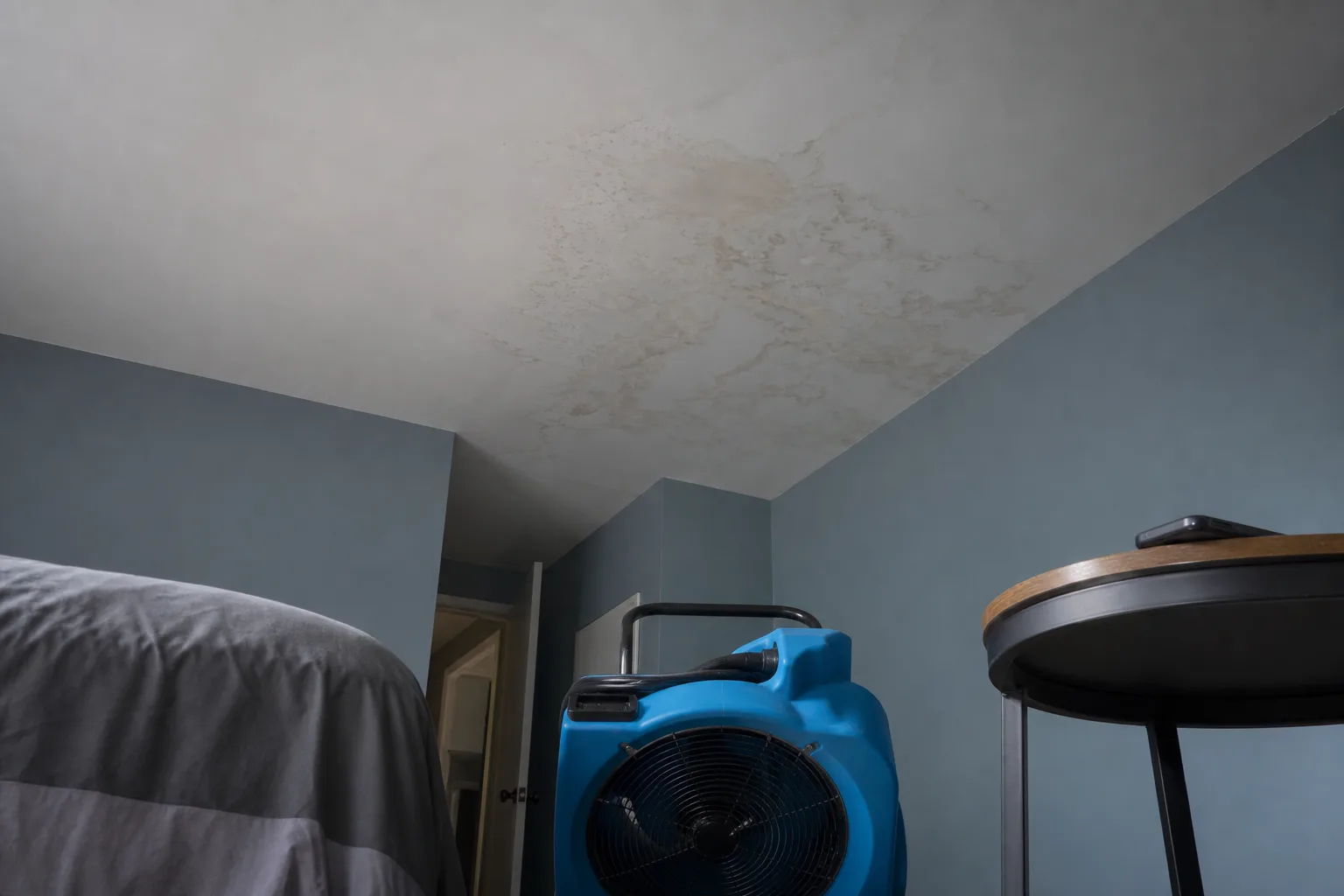
The decisions that cost the most in a water loss are usually made by people who have never made one before, inside the first few hours, while the floor is still wet and nobody has slept. That is the structural problem with the first forty-eight hours: the judgement required is specialized, the pressure is high, and the reader has no practice. What follows is a reconstructed account of one loss in a two-unit building, told from the downstairs owner's side, with attention to the choices that turned out to matter and the ones that only felt urgent. The neighbor upstairs is the second character, and not an incidental one.
The first forty minutes went to the neighbor, not the insurer
The stain appeared in a bedroom ceiling on a weekday morning, spreading visibly, which meant the source was still running. The downstairs owner did the one thing that is almost always correct and almost never regretted: she went upstairs and knocked. The neighbor was home, had noticed nothing, and found a failed braided supply line under a bathroom vanity. He shut the fixture stop. Total elapsed time, by her later reconstruction, was under twenty minutes from the first stain to a dry source. Nothing else she did in the next two days saved as much water damage as that knock.
That sequence is worth naming because the instinct runs the other way. The reflex under stress is to photograph, to call the insurance company, to search for a restoration contractor, all of which are reasonable and none of which stops water. In a shared building the shutoff is frequently not yours to operate, and the person who can operate it may be asleep, at work, or unaware anything is wrong. Knowing in advance who holds the keys, where the building's main is, and which neighbor answers a phone before eight in the morning is preparation that costs nothing and pays exactly once.
Documenting a loss that begins in someone else's rooms
Her second decision was to photograph both units, and to ask before doing it. The upstairs owner had no obligation to let her into his bathroom with a phone camera, and a refusal would have been within his rights; she asked plainly, explained that her insurer would want to see the source and not just the result, and he agreed. She took the failed line, the cabinet floor, the vanity, and then went back down and photographed her ceiling, the wet carpet, and the baseboards. She timestamped nothing manually. The phone did that for her, which is the point.
Evidence gathered in the first hours has a quality that evidence gathered later cannot recover, because it shows the loss before anyone touched it. Adjusters, whether hers or his, reconstruct causation from what they are shown. A photograph of a failed component still in place, taken before a plumber removes it, settles arguments that would otherwise run for weeks between two carriers over whether the failure was sudden or a long-running seep somebody ignored. She also asked the neighbor to keep the old supply line in a bag rather than throwing it out. He did. That bag later ended the causation question in a single conversation.
Two carriers, one wet building, and the question of who calls first
By midday there were two open claims, one on each policy, which is normal and not a sign that anyone is at fault. Her policy covered her ceiling, her carpet, her belongings. His covered his bathroom and, potentially through subrogation, whatever her carrier eventually paid on his account. The choice she made here was to report promptly to her own carrier and to stop there, without any conversation about blame, reimbursement, or who was going to make whom whole. She did not ask him for money. She did not tell him she wouldn't.
This is where neighbor losses go wrong, and the failure is social rather than technical. A homeowner with a wet bedroom and a four-figure deductible will feel, reasonably, that the deductible is not hers to absorb. Saying so on day one, to a neighbor who is himself standing in a flooded bathroom, converts a shared misfortune into an adversarial matter before either insurer has looked at anything. The carriers have a process for allocating cost between themselves. It is slow, it is largely invisible to policyholders, and it works better when the two households are still exchanging text messages.
Choosing a restoration company under time pressure
Drying equipment needed to be in the building the same day, and she had no basis for picking a firm. She made three calls, asked each the same four questions, and chose on the answers rather than the arrival time. She asked whether the price was a published unit rate or a number invented for her. She asked what the scope was in writing before anything was signed. She asked who the contract obligated her to, and she asked whether signing anything assigned her insurance benefits to the company. That last question is the one that reliably changes the conversation.
An assignment of benefits gives the restoration firm the right to bill and negotiate with the insurer directly, which suits some households and traps others, and it is frequently buried in an authorization form handed over on a clipboard at the door. She declined to sign one and the firm still came. Reversibility was the standard she applied throughout: run the dryers now, because that is reversible; sign away claim rights now, because that is not. The Environmental Protection Agency is the federal body responsible for guidance on moisture and mold in buildings, and the general principle it reflects, that wet materials need drying quickly, does not require you to surrender anything to get it done.
What the judgement actually consisted of
Looked at afterward, her good decisions shared one trait: she separated the things that decayed with time from the things that did not. Stopping the water decayed by the minute. Photographing the source decayed by the hour. Choosing a contractor decayed by the day. Settling money with the neighbor did not decay at all, and could safely wait until two adjusters had done their work. Sorting the forty-eight hours by that clock, rather than by what felt most alarming, is most of the skill, and it is learnable before you need it.
Six weeks later, both units were repaired, both carriers had paid, and the two owners had between them installed shutoff valves they could each reach. The upstairs neighbor still brings in her packages. That outcome was decided, in most of its particulars, on the first morning.