Four Tasks Kept, Eleven Dropped. What One 1913 House Did With the Difference
A household's maintenance binder, read against what actually happened to the house, shows which chores survive contact with real life and which quietly stop.
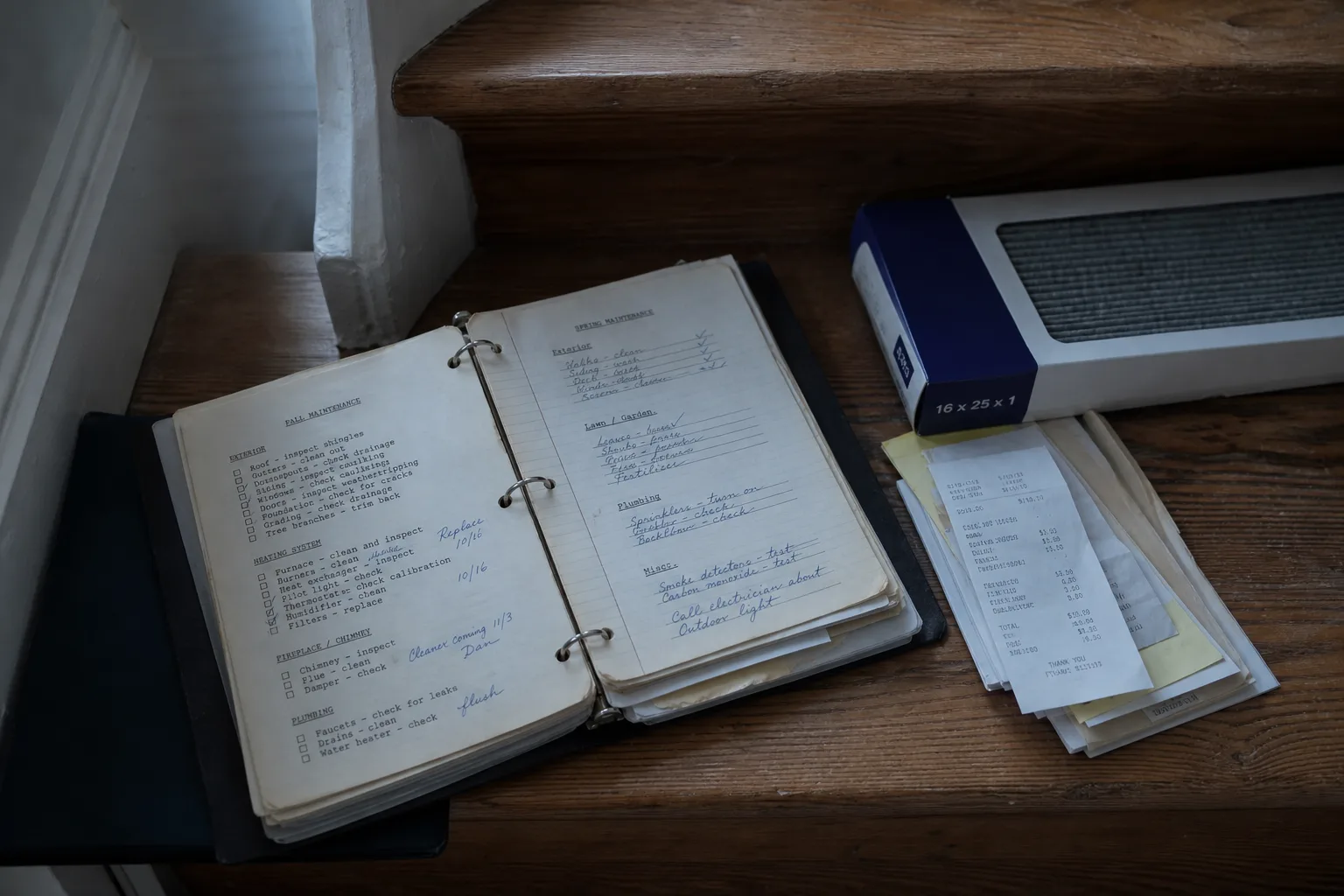
The binder came with the house, which is more common than people think. A 1913 foursquare in a river city, sold in 2016 by the second family to own it, handed over with a three-ring binder of seasonal tasks typed by the previous owner and annotated in two different hands. Fifteen items, grouped by season, with boxes to check. The current owners shared the binder and seven years of their own receipts on the condition that the address stay out of print. Read together, the two sets of paper answer a question most maintenance advice avoids: not what should get done, but what actually does.
Four tasks survived the first three years
Furnace filters, gutter cleaning, the chimney sweep, and the sump pump test. Those four show up in the receipts every year without a gap. The filters survived because a subscription box arrived four times a year and sat by the basement stairs until somebody dealt with it. The gutters survived because a crew came unasked each November and sent an invoice. The sweep survived because the insurer asked for proof after a neighbor's chimney fire. The sump test survived because it took ninety seconds and the basement was where the laundry was. Nothing about those four reflects diligence. Each one had a prompt attached to it that came from outside the household.
The eleven that stopped, and where they turned up later
Caulking the south elevation, washing the painted siding, swapping storm sash, lubricating window pulleys, checking the grade at the foundation, draining the water heater, clearing the dryer vent, testing the GFCIs, flushing the condensate line, oiling the garage door, and walking the roof edge with binoculars. All eleven appear in the binder. None appear in the receipts. The consequences arrived over four years and were never filed under maintenance by the people paying for them. A painter's estimate for the south and west elevations ran roughly double the north and east because the failure was not cosmetic; the film had opened and the wood underneath had gone soft at the lower courses. That is a caulk-and-wash item presenting as a carpentry item.
The rest followed the same pattern. Two sash cords parted in one winter, which turned a ten dollar cord into a sash removal because the pulleys had seized dry. The water heater failed at eleven years with a sediment layer the plumber described and photographed, and the replacement happened on a Saturday at a Saturday rate. The dryer took longer per load for two years before anybody timed it. In none of these cases did the household connect the bill to a skipped line in a binder. They connected it to the age of the house, which is the explanation an old house always offers and the one that is usually only half true.
What the house was built to expect
A 1913 frame house was designed around labor that was assumed to be available and cheap. Painted wood siding was a system that expected washing and a repaint on a short cycle, not a twenty-year coating. Wood storm sash expected two changeovers a year, which meant somebody handled every window twice annually and noticed the glazing putty while they were up there. A coal furnace expected daily attention, so the basement got visited every day of the heating season. The maintenance was not scheduled so much as it was unavoidable. Strip out the labor and the inspections go with it, which is the part most conversions leave behind.
This house had been converted twice: coal to oil, oil to gas, with the chimney relined at some point in the 1980s and the storms replaced with aluminum triples in the 1990s. Both changes were improvements by any reasonable measure. Both also removed a recurring reason to look at something. The triple-track storms meant nobody touched the windows for twenty years, which is exactly how long it took the pulleys to seize and the lower glazing to open up on the weather side.
What changed in 2023, and why it worked
The rebuild of the schedule came after the painter's estimate, not before it, which is the usual sequence. The owners did not add discipline. They attached each surviving task to something already on the calendar. The siding wash and the caulk check moved to the week the gutter crew came, and the crew was asked to quote both. GFCI testing and the condensate flush moved to the two clock changes. The dryer vent moved to the chimney sweep's visit, since the sweep already carried the brushes. The roof walk became a photograph taken from the driveway on the first of each month, filed by date, compared twice a year. Eleven orphaned tasks became four anchored ones.
One change was not the household's idea. Pre-1978 housing brings the federal lead-safe renovation rules into any work that disturbs paint, and the Environmental Protection Agency oversees the certification and work practice requirements that apply to contractors doing that work. The washing and scraping on the south elevation had to be done by a certified firm with containment, which cost more than a day of ladder work but produced a written scope, a record of which courses were replaced, and photographs. That documentation is now the baseline the monthly driveway photo gets measured against, and it is the first thing a buyer or an adjuster will be shown.
The binder is still in the house. The current owners added a page at the front listing the four anchors and what rides along with each, and they left the original fifteen items behind it, because the list was never wrong. It simply had no clock attached. Any schedule that depends on somebody remembering in March what they wrote down in October is a schedule that will be kept for two years and then quietly become a record of intentions. Tie the task to a truck that is already coming, and it gets done.